At the Desk · process
Will a Footrest Fit Under Your Desk? Check the Base and Moving Space
A footrest can provide enough room for your feet and still collide with a desk crossbar. Before choosing one, measure where the obstruction sits, how far the chair needs to approach, and the space occupied by the base and platform during use.
Start with the desk you already have. This worksheet helps you reject an obvious mismatch, identify a workable position, or send a precise drawing request before buying. The model examples were checked on November 6, 2026. Coolkeel has reviewed their documents and has no hands-on fit measurements for them.
Map the obstruction with the chair in place
Set the chair and keyboard to the positions you normally use. Sit back in the chair, then note where your feet rest and where a footrest would need to sit. Move the chair aside for measuring and return it to the same position for the approach check.
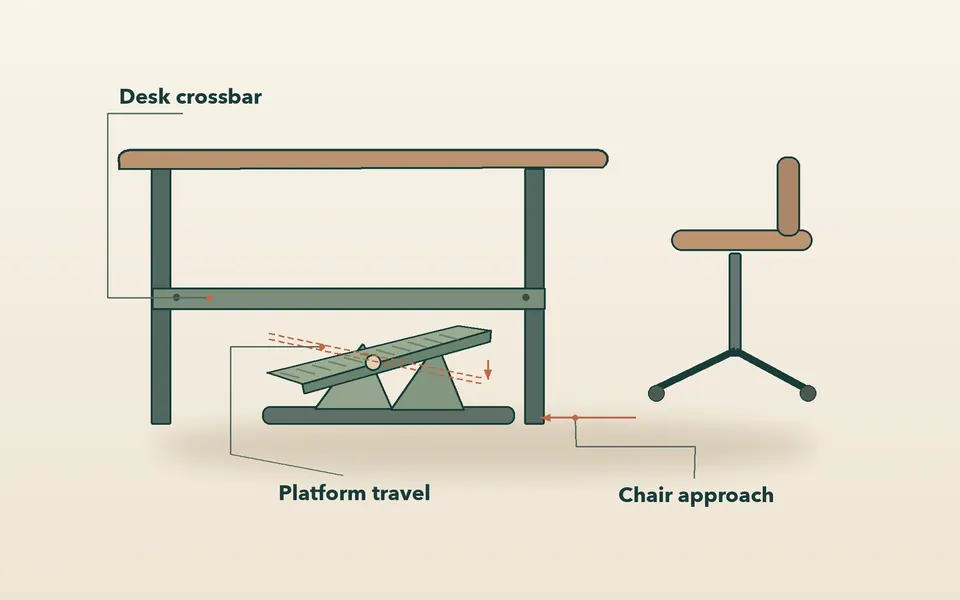
Record the front edge of the desk as a reference. Measure the distance inward to the near face of the crossbar, the crossbar’s thickness, and the height of its lower edge above the floor. Also locate desk legs, a cable tray, storage and the chair base. A bar above the floor can allow part of a base beneath it while still obstructing a raised plate or a shoe.
OSHA’s workstation guidance calls for enough space under the desk to change position and keep legs and feet clear of stored items. Use that clearance check before adding another object. OSHA desk guidance
| Measurement | What to record | What it helps you decide |
|---|---|---|
| Width between obstacles | Clear width at floor level and at the proposed plate height | Whether the base and plate can occupy the same position |
| Crossbar position | Distance from desk front, bar thickness and lower-edge height | Which part of a footrest could meet the bar |
| Chair approach | Chair position needed to reach the keyboard, including its base | Whether the footrest would force the chair farther away |
| Foot position | Usable plate location with your ordinary footwear | Whether a physically fitting unit would be reachable |
| Adjustment access | Space for your foot or hand to reach the control | Whether you could operate the chosen setting |
Keep the measurements in one unit and sketch the desk from above and from the side. Photograph the obstruction beside the tape measure if you will ask a supplier to check it.
Ask for three kinds of product dimensions
The base footprint is the space occupied by the supports on or close to the floor. The platform is the surface supporting your feet. The moving space is the full space used by the platform and mechanism as they tilt, rise or rock through the positions you intend to use. A product’s overall width, depth and height may leave one or more of these questions unanswered.
For a fixed platform, compare the complete outline and height at the intended location. For an adjustable platform that locks, check the movement needed to reach the setting and the position of its control. For a continuously rocking design, check the whole intended motion. A platform that clears the crossbar while level may meet it as an edge rises.
Use a paper outline of verified base dimensions to check floor placement with the chair. Draw the platform outline too if it extends farther. This can eliminate a position blocked by a desk leg or chair base. Vertical clearance and movement still require a side drawing or a careful physical check using the manufacturer’s instructions.
Read the model documents together
Two current examples show why the drawing matters.
Humanscale FR100. The current FR100 page lists 12.25 inches deep, 16.75 inches wide and 4.5 inches high. However, its linked Foot Rockers brochure labels those dimensions as FR500 and gives the FR100 as 19 inches wide, 11.75 inches deep and 3.375 inches high. Save the discrepancy with the FR100 item code and ask which drawing describes the unit being supplied. The documents do not establish whether this comes from a listing error, revision or another cause. FR100 product page · Foot Rockers brochure, page 4
The FR100 page describes friction angle adjustment. Neither the checked page nor brochure gives a separate dimensioned base footprint and full clearance through every usable angle. Those are the fields to request for a low crossbar.
Kensington SoleMate Comfort, UK SKU 56153. The manufacturer page identifies a locking foot pedal. Its linked shared quick-start guide covers K56144, K56146, K56153 and K52789. The diagram on page 3 shows a height-setting control and a separate pedal-controlled tilt operation. Leave room to reach the pedal as well as to place the platform. UK SKU 56153 page · Shared quick-start guide, page 3
The same page states 89–127 mm height adjustment, while the shared diagram labels 90–120 mm. Its overall dimension row also needs clarification before using it as a floor footprint. Ask Kensington to match the current SKU to a drawing with clearly labelled width, front-to-back depth, height and setting. Keep these fields unresolved until that answer arrives.
Make a fit decision before opening a returnable purchase
Use three outcomes for each candidate.
- Exclude this placement when a verified rigid base is wider than the available space, a required plate position overlaps the crossbar, or the chair cannot reach its working position with the unit present. Record the specific collision so the next candidate addresses it.
- Request the missing drawing when a key dimension is absent, its axis is unclear, or the model sources disagree. Send the two desk sketches, the exact SKU, your intended setting and the conflicting source links. Ask for both base dimensions and the highest or farthest occupied point during adjustment.
- Arrange a permitted fit check when the documented geometry leaves room. Check the seller’s assembly and return conditions first, retain packaging, and follow the unit’s own setup instructions. With the chair stationary, check the intended positions slowly and stop when any part contacts an obstacle. Include your shoes and access to the controls in the check.
A useful manufacturer question is, “For this SKU, can you show the base width and depth, platform overhang, and front and rear heights through the supported tilt range? My desk crossbar is in the position shown in these two sketches.” This gives support the measurements needed to answer your particular obstruction problem.
If the chair and desk settings themselves still need work, complete the office-chair fit checklist first. Record purchase conditions with the comfort-accessory return checklist before planning a physical trial.
Questions and answers
Does a small footplate mean a footrest has a small footprint?
The support frame, adjustment mechanism or pedal may extend beyond the plate. Ask for the base width and depth as well as the platform dimensions, and compare both with the obstruction under your desk.
Can I judge a tilting footrest from its overall height?
You also need the platform height and occupied space through the positions you intend to use. Keep shoe clearance, the desk crossbar and access to any pedal in the same fit check. A single overall dimension may describe only one position.
What should I do when a product page and its brochure give different dimensions?
Save both sources with the exact model, SKU and market. Ask the manufacturer for a current dimensioned drawing showing the base and intended adjustment positions. Keep the purchase on hold until the conflict affecting your fit decision is resolved.