At the Desk · comparison
Personal Air Cooler vs Desk Fan: Check the Room and Water Routine
Start with a plain desk fan if you want directed airflow without handling water. Consider a personal evaporative cooler only after checking that added moisture, ventilation and regular water care fit the place where you will use it. If your goal is a lower temperature throughout the room, investigate the room’s cooling arrangements before buying either device.
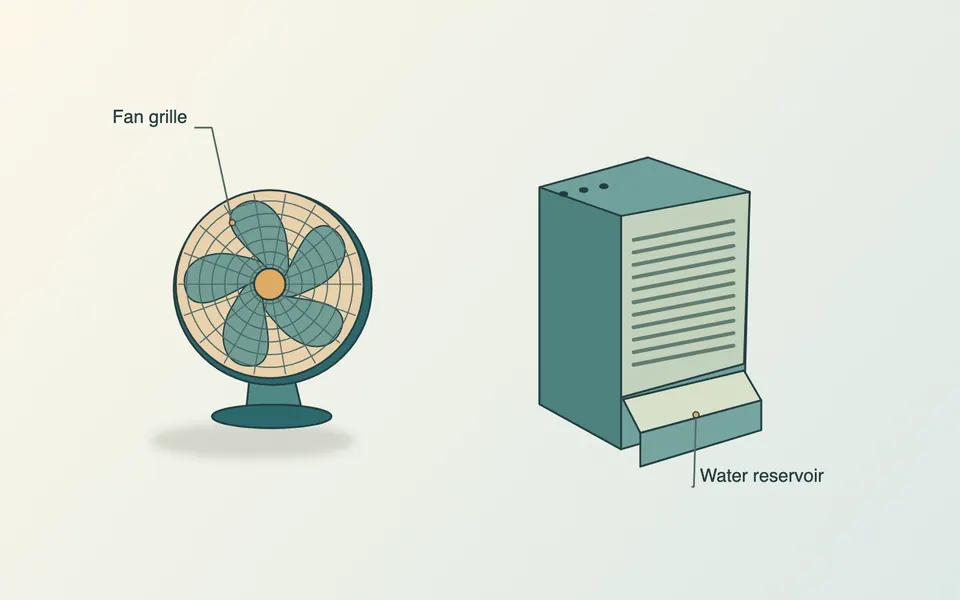
This guide compares a circulating desk fan with a small direct evaporative cooler that passes air through wet media. It does not cover every technology sold as an air cooler. For workplace permission and agreement with nearby colleagues, use the separate shared-office fan checklist.
Identify what the device actually does
Do not choose from a photograph or the words “mini air conditioner.” Open the manual and look for the mechanism and installation section.
| Device described in the manual | What to identify | Question it can help you answer |
|---|---|---|
| Plain circulating fan | Motor, airflow controls and no water-based cooling system | Can I direct a breeze where I sit? |
| Direct evaporative cooler | Water tank, wetted media and instructions for an evaporative mode | Can this location accommodate added moisture and the required water routine? |
| Refrigerant air conditioner | Compressor/refrigerant system and instructions for rejecting heat outside | Can the required installation work in this room? |
The U.S. Department of Energy explains that fans move existing air rather than produce cooled air. Honeywell’s air-cooler support page distinguishes water evaporation from refrigerant air conditioning and notes the moisture produced by evaporation. A tank is a useful clue, but confirm what it does; the label alone is insufficient.
Keep your purchase goal specific: airflow at one seat, or a change to the room environment. If an existing fan leaves the whole room unsuitable, buying a water-based appliance without checking the room constraints may leave the original problem unresolved.
Check the location before comparing features
Honeywell’s safety and maintenance guide calls for cross-ventilation when cooling and advises against evaporative cooling in high ambient humidity. These are manufacturer conditions, not a promise of a particular result at your desk.
Use the following as a buying decision, not as a test of cooling performance:
| Your constraint | Decision before buying |
|---|---|
| Added moisture is unwanted around the workspace or its contents | Exclude direct evaporative operation; consider a plain fan for airflow. |
| Windows and doors cannot be used as the chosen manual requires | Do not plan to run that cooler in evaporative mode there. Ask facilities about the room instead. |
| You do not know the room’s humidity conditions | Resolve that question against the model’s instructions; do not infer it from the weather forecast alone. |
| Nobody can take responsibility for refilling, cleaning and drying | Choose equipment without a wet-media routine, or postpone the purchase. |
| You need room cooling rather than a breeze at your seat | Discuss a suitable installed or portable cooling arrangement with the person responsible for the space. |
Do not open workplace windows or doors against building rules to make a purchase fit. Resolve the location first.
Read a real manual before committing to the water routine
The Honeywell Zeta DCS2AE manual, read on October 5, 2026, lists U.S. and Canadian support. It specifies domestic use, so this is a home-use example, not workplace approval or a recommendation to buy it.
Its instructions include:
- Unplug before refilling, cleaning or moving it.
- Use fresh, clean water; empty and refill the tank weekly, and clean the honeycomb regularly.
- Provide cross-ventilation in cooling mode.
- Dry all parts before seasonal storage, using the stated fan-only procedure.
Match the manual and electrical rating to the actual unit sold in your country. A regional website or similar product name does not establish that match. These instructions illustrate the ownership work; they do not establish cooling performance against another appliance.
Make a care plan you can actually follow
Before ordering a water-based cooler, write down five answers:
- Exact unit: What model and regional manual will arrive with it?
- Water route: Where will you refill and empty it, and can you follow its carrying and disconnecting instructions?
- Care access: Which parts need cleaning, and are the required materials or replacement media obtainable locally?
- Time away: Who will follow its shutdown and storage instructions during leave or a longer break?
- Fit: Does the manual permit the intended location and leave enough space for its intake, outlet and servicing?
An unanswered item is a reason to ask the manufacturer before paying. Do not substitute a cleaning mixture, oil, ice or frozen insert merely because another model allows it.
Once the appliance type fits, compare the controls, direction of airflow and sound at the setting you expect to use. For alternatives that do not involve a water-based appliance, see neck wraps, desk fans and cooling sprays. Keep the decision tied to a workable daily routine rather than a promise on the box.
Questions and answers
Is a mini air conditioner the same as an evaporative cooler?
The name alone does not identify the appliance. Check its manual for the cooling mechanism. A direct evaporative cooler passes air through water-wetted media; a refrigerant air conditioner has different equipment and installation requirements.
Is a personal evaporative cooler suitable for a humid office?
Do not assume so. Direct evaporative cooling adds moisture, and the manufacturer's humidity and ventilation conditions matter. If added moisture is unwanted or the required ventilation cannot be provided, rule out that operating mode for the location.
Can an evaporative cooler run without using water?
Only use a mode the exact manual permits. The Honeywell DCS2AE example has a fan-only setting, but that is not permission to remove its cooling media or run its water pump with an empty tank.
Which is simpler if I do not want to refill or clean a tank?
A plain desk fan avoids a water tank and wet-media routine. It still needs the care and suitable placement stated in its own manual. Choose it for directed airflow, without expecting it to lower the room's temperature.