The 3 a.m. · process
Will an Under-Bed Storage Box Fit Through Your Bed Frame?
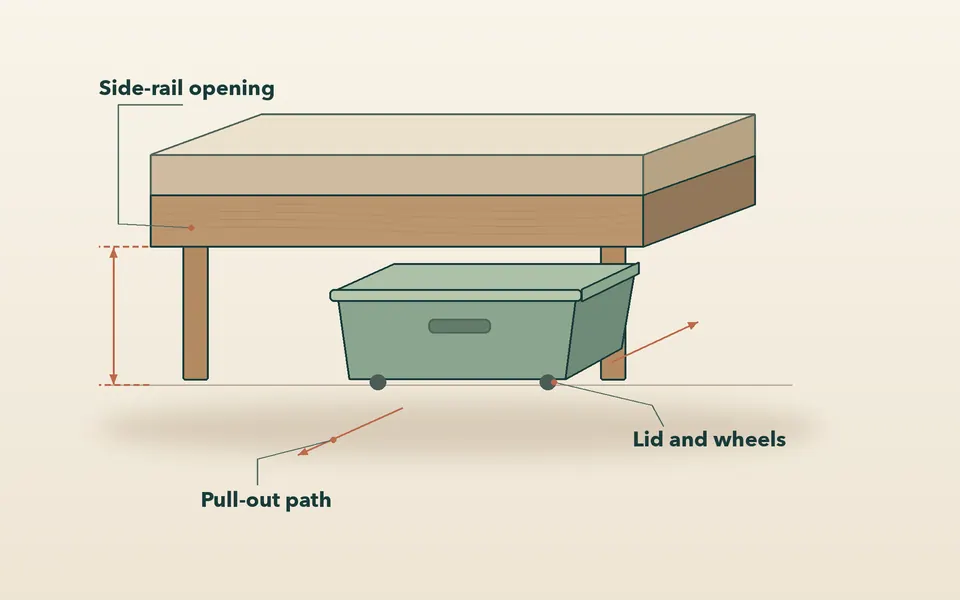
Start at the side of the bed where you will reach for the box. Can the closed box pass under that edge, travel to its parking spot and come back far enough to open? A tall space beneath the slats can sit behind a lower side rail. A bedside table can leave room to get a box halfway out and still cover the end where you need to lift the lid.
Take a tape measure and sketch the box’s route on paper. Keep the bed, rug and nearby furniture in the positions you expect to use every day.
Measure the entrance and parking space
Choose the direction of entry first. Label the edge of the box that will face you. Its width must pass between the legs at the entrance. The dimension pointing under the bed tells you how far the box will extend toward a centre support or the opposite side.
| Place to measure | What to write down |
|---|---|
| At the rail | Floor-to-rail height at both ends of the intended opening and anywhere the rail hangs lower |
| Between the legs | Narrowest clear width across the route, including feet that project inward |
| Beyond the rail | Available distance to the first support or other obstruction, plus any lower crosspiece on the route |
| In the room | Clear distance from the opening to the first piece of furniture or wall in the pull-out direction |
Measure from the surface the box will actually cross. A rug ending at the bed edge can put the box higher at the entrance than at its parking spot. Look along the whole width the box will occupy. A high reading beside one leg tells you little about the middle if a fitting projects below the rail. Leave supports in place. If an interior dimension is inaccessible, use the exact frame drawing or mark the dimension unknown.
Find the outside dimensions of the assembled box
On the product page, identify the exact article number and open its measurement drawing. Check how the arrows relate to the lid, rim, handles and wheels. For a fabric bag, ask for the shape and size when filled if its listed dimensions refer only to the empty bag.
For example, IKEA UK’s SOCKERBIT box with lid, article 204.115.24 is 77 cm long, 50 cm wide and 19 cm high. The drawing shows those dimensions around a closed box with its broad rim. The packaging section gives heights of 3 cm and 18 cm for the two packages. The drawing answers the question about the box you will slide under the bed. Adding the two package heights would give a different figure.
IKEA UK’s SMYGA bed storage box, article 705.078.21 illustrates a different trap. Each drawer is listed at 99 cm wide, 91 cm deep and 29 cm high. The separate 20 cm inside height describes room for contents. The drawing shows two drawers, each with a 99 cm front, spanning 198 cm together. The product details describe four wheels and identify the SMYGA bed frames the drawers were designed for. If you are considering one for a different frame and the margin is close, ask for the floor-to-highest-point measurement with all wheels fitted.
Rehearse getting something out
Mark the footprint of one box on the floor with loose strips of paper. A piece of cardboard cut to the footprint is also useful. Align the front with the rail, then move the outline straight toward you. Leave the bedside table where it normally stands. See whether the outline reaches the position where you could lift the lid, remove a folded blanket or look into the back of the drawer.
The outline checks floor space. To check vertical clearance, compare your smallest measured opening with the height of the complete closed box. Use the same units and keep the original measurements. If the two figures are equal, the figures leave no allowance for movement. A rim rubbing the rail or a wheel crossing the rug edge can affect the trip. There is no single gap that works for every floor, box and frame.
Try a second orientation on paper if space is tight. Turning a rectangular box changes the width that must pass through the opening and the depth needed under the bed. For a wheeled drawer, check the direction the maker intends it to roll and whether you could reach the intended front in that orientation.
Decide while you still have the measurements
Cross off a box if any known outside dimension exceeds the corresponding clear opening, or if the only place to open it is occupied by furniture. Keep a close match pending if the maker lists only the inner height or leaves wheel height unclear. Ask the supplier, “With the lid closed and supplied wheels fitted, what is the overall height from the floor, including the highest part of the rim?”
If every part of the route and the opening position checks out, save the article number, configuration and measurements with your shortlist. For a borderline order, check whether assembly affects your return options using the accessory return checklist. If you are considering changing the bed height itself, the bed-riser leg-fit checklist covers the separate questions about feet, supports and frame-maker permission.
Questions and answers
Which height should I measure under my bed?
Measure from the floor or rug the box will travel on to the lowest part of its route. Check the entry rail and accessible points farther in. Write down the smallest opening and its location.
Can I use the package height to choose an under-bed box?
Use the dimensions of the assembled box in the configuration you plan to store. IKEA UK's SOCKERBIT 204.115.24 drawing gives the closed box a height of 19 cm. Its two package heights are 3 cm and 18 cm.
What if the drawing shows wheels but I cannot tell whether the stated height includes them?
Ask for the overall distance from the supporting floor to the highest point with the supplied wheels fitted. Keep a close fit undecided until the manufacturer confirms that dimension.
How do I tell whether I will be able to get the box open?
Mark where the box must stand to reach what you want. Check the floor space for that pull-out distance and the overhead space needed by the lid. An open drawer still needs room to reach inside.