The 3 a.m. · process
Before Buying Bed Risers: Check Every Leg and the Recess Fit
A bed riser can have the height you want and still be the wrong match for the feet already on your bed. Start with two separate questions: does the exact foot fit the intended attachment, and does the bed maker permit that complete arrangement? A dimension can help answer the first. It does not settle the second.
This is a buying checklist for an existing bedroom frame, not instructions for lifting it or changing its supports. If the bed identity or permission is unresolved, collect the missing information before ordering.
Record the whole frame before comparing risers
Find the bed label, model, order confirmation and assembly instructions. Record the manufacturer’s name and the country or version supplied. A mattress brand is not necessarily the frame’s identity.
Use the assembly diagram to list every support, including any centre supports. Do not assume the feet visible at the corners describe the whole arrangement. Keep the frame in its existing assembled state while collecting accessible information; do not remove a foot to investigate a possible purchase.
Make one row for each type of support:
| Existing part | Information to record | Question to resolve |
|---|---|---|
| Square or rectangular leg | Foot width and depth; any taper or projecting pad | Does the maker specify this shape and footprint? |
| Round leg | Diameter at the contact end, not just higher up | Is that the dimension required by the recess specification? |
| Caster | Wheel and frame identity; relevant assembly drawing | Does the candidate hold the wheel or replace a component? |
| Centre support | Position, foot shape and part number where available | What arrangement does the bed maker require here? |
If a dimension cannot be checked without dismantling or moving the frame, mark it unknown and ask the supplier for the drawing. A complete record is more useful than guessing a missing measurement.
Read the opening specification, not just the product height
An outer product dimension, an opening diameter and an allowed square-foot size describe different things. Write each in its own field. Keep the supplier’s units so that rounding does not create an apparent fit.
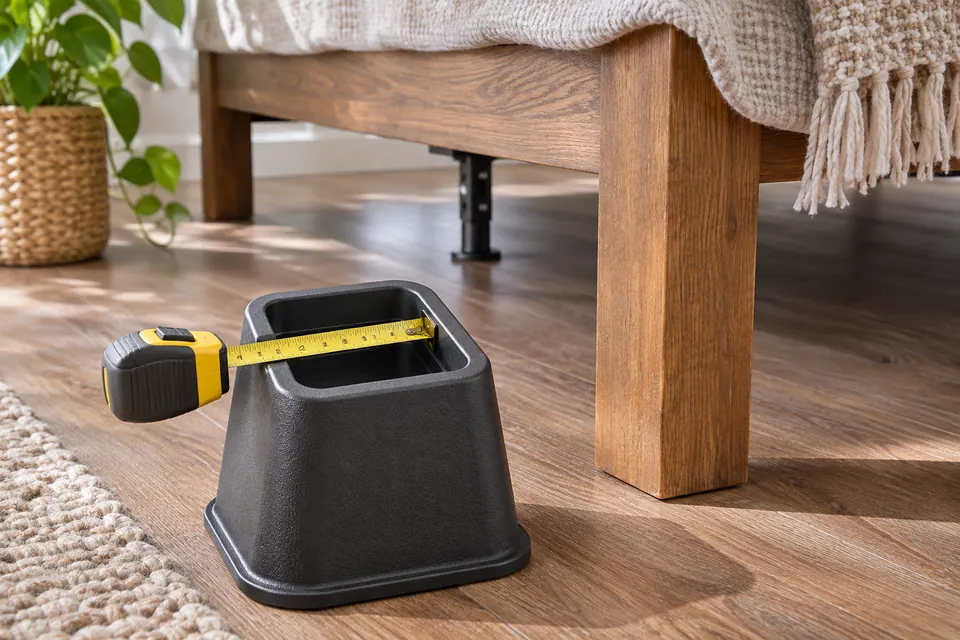
For example, the current Slipstick CB671 product page describes a top recess 76 mm in diameter and 19 mm deep, and separately specifies square posts up to 56 mm. Its stated caster specification is also separate. The circular diameter therefore should not be copied into the square-leg field.
These are specifications for that named riser, not measurements of your bed. They do not establish that a wide, tapered or irregular foot is accepted, or that your frame may be raised. Where the description does not identify the shape you have, ask the manufacturer for an explicit answer instead of treating empty space in a photograph as clearance.
Identify what the riser connects to
Two items sold as bed risers may connect to different parts of a frame. Compare the manufacturer’s words and drawings before comparing prices or pack sizes.
Tech Team #740 is described as a replacement for casters on metal bed frames. Its product photographs show a sleeve-like opening offered to a metal-frame foot. That is a different arrangement from placing an existing broad furniture foot into a recessed cup.
The phrase “standard bed frame” does not identify your frame. The pictures illustrate the manufacturer’s product; they are not instructions to remove your casters or proof that an unidentified socket, leg or centre support matches. Save the exact model reference when asking about compatibility, rather than sending only a picture of a similar-looking accessory.
Obtain the bed maker’s answer as well
Ask whether the exact frame can be raised using the proposed product, and what requirements apply to all its supports. Include the riser model, desired change and the support record. Ask for the applicable instructions, including any limits or exclusions, rather than a general answer about bed risers.
A maker’s statement may have a narrow scope. IKEA UK’s bed-leg guidance discusses its legs for IKEA mattress bases and wooden-base sprung mattresses. That is not blanket approval for an unidentified bedstead, adjustable base or third-party riser.
Record the answer against your exact model. An unanswered email, silence in an old manual or a retailer’s broad compatibility description leaves permission unresolved. If the maker specifies a different accessory, check that accessory’s own identity and instructions rather than substituting one with similar dimensions.
Separate a fit comparison from a purchase decision
Use three outcomes in your shortlist:
- Does not match: a stated shape or dimension excludes the existing foot. Remove that candidate without trimming or adapting the foot.
- Information missing: the interface, complete support arrangement or frame permission is unclear. Keep the question open and request the relevant documentation.
- Documented option: both manufacturers’ applicable information identifies the combination and its conditions. Use those instructions for any next step; this checklist does not replace them.
Do not turn a per-item load claim into a rating for the complete bed by multiplying it by the pack count. Nor does an extra riser establish how an unlisted centre support should be treated. Load, installation, floor and support requirements belong to the exact approved arrangement.
For a return-policy check before ordering an identified option, use the comfort accessory return checklist. If your actual problem is a fitted sheet coming loose, record the mattress stack separately with the pocket-depth checklist; raising the frame does not resolve sheet sizing.
The useful result is a documented match or a specific unanswered question. Neither a desired lift height nor a large pack makes an unknown frame compatible.
Questions and answers
Will a riser with a three-inch opening take a three-inch square bed leg?
Do not use a circular opening's diameter as its square-leg allowance. Look for a separate square-post specification. The Slipstick CB671 example lists a 76 mm recess diameter but a 56 mm square-post limit; those are different measurements.
Are caster-replacement risers the same as cups placed under existing feet?
No. Check the interface the maker describes. Tech Team #740 is described as replacing casters on metal bed frames, while the Slipstick example describes a recessed holder. Neither description identifies an unknown bed or approves changing its supports.
Does buying six risers settle the centre-support question?
No. A pack count does not establish the number, shape or treatment of the supports on your frame. Record every support from its assembly instructions and ask the bed maker how the complete frame would remain supported.
Can I buy risers if I cannot identify the bed frame?
Treat the purchase as unresolved. Gather the label, order record, assembly instructions and photographs for identification. A matching recess or a retailer's generic compatibility statement does not establish the frame maker's permission to raise that bed.