At the Desk · process
Long Shifts Without a Desk: Plan Storage and Changes
When you work a long shift without a personal desk, organize supplies around where you may keep them, when you can reach them and who can help if access changes. Buying a smaller kit will not solve a locked staff room, an unavailable changing space or an unapproved charger.
Start with the actual shift: its work areas, handovers and permitted breaks. This guide offers a planning checklist, with specific UK workplace examples. It does not establish your employer’s policy or a universal right to carry a particular item.
Map storage and changing access
Use a simple division: items permitted with you, supplies at an agreed storage point, and things left at home because there is no workable arrangement. Do not assume a trolley, shared counter or empty chair is personal storage.
| Place | What to decide | Question that makes the plan usable |
|---|---|---|
| With you | Only items permitted for the task and clothing | Can I carry this without interfering with work, equipment or required hygiene? |
| Agreed storage point | Spare clothing and other permitted supplies | Can I reach it during this shift, including after a department closes? |
| Changing location | A suitable place and opportunity to change | Who confirms access and arranges cover if I cannot leave immediately? |
| End-of-shift destination | Where used items go for the journey home | How will I separate them and follow the required cleaning routine? |
The HSE’s workplace-facilities guidance identifies drinking water, clothing storage, changing facilities where special work clothing is worn, and rest/eating facilities. That is a UK guidance framework, not confirmation that a particular room or locker at your site is available to you. Ask for its location and access arrangements.
Check access, not just the storage label
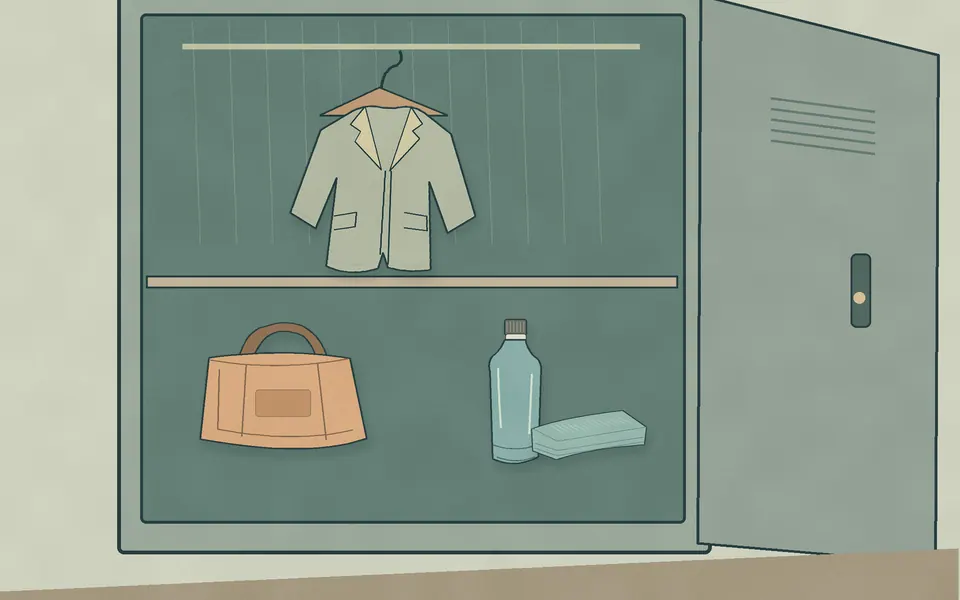
A locker number is only part of the answer. Check who provides the key or code, whether it must be returned between shifts, and what happens when you move to another work area. Ask whether storage is shared, cleared overnight or reassigned to the next person.
For a mobile role, map the points where you actually return to base. Keep the plan on a small note:
Shift area → storage location → access method → permitted retrieval opportunity → fallback contact.
There may be no conventional locker. For example, HSE construction guidance describes secure storage in a site office or even a van on smaller sites. It also says contaminated protective equipment should be separate from everyday clothing. These are construction-specific examples; they do not make your car or an unapproved cupboard a suitable substitute.
If your route changes midway through the shift, ask whether the supplies should move with you or stay at one accessible base. Check both the permission to move them and the practical opportunity to retrieve them.
Make a spare change complete enough to use
Decide which approved garments you would want to replace. Pack them together so that retrieving a top does not leave its required companion item elsewhere. Check the uniform-layer guide for garment permission; this step concerns getting to the change and managing the used clothing.
Agree these details before relying on the spare:
- A suitable changing location and how to access it.
- The person to notify if you need to step away.
- Any task cover or handover required.
- The local method for containing and laundering used workwear.
- What to do if the room is occupied or unavailable.
Do not improvise with protective clothing or take contaminated workwear home contrary to workplace instructions. If changing access cannot be arranged, return to the supervisor with that specific gap rather than treating the packed spare as a complete solution.
Separate charging availability from permission
A visible socket or USB port does not answer which devices may use it. Ask about the exact personal device, its charger, the permitted location and whether you may leave it there. Follow the equipment instructions and local approval process.
A concrete example shows why wording matters. The Princess Alexandra Hospital NHS Trust’s January 2024 announcement describes public charging lockers for mobile devices, while its staff-area installation is described for trust-issued devices. That announcement does not authorize staff to charge personal fans in those facilities.
If permission or access is unresolved, plan without workplace charging. For an approved fan setup, the shared-office fan checklist covers placement and power questions in more detail.
Rehearse the arrangement once
Before the shift, walk through getting the key, finding the supplies and reaching the changing location. Check drinking-water access separately from where your bag is stored. Ask the shift contact how to flag a problem without abandoning a task.
At the end, collect your belongings, follow the cleaning instructions and replace anything used. Note one practical failure, such as inaccessible storage after a handover, and agree a correction before the next shift. A useful arrangement is one you can actually use when duties and locations change.
Questions and answers
What should I carry if I cannot keep a bag beside me?
Start with what the task permits you to carry, then agree a reachable storage location for everything else. A small bag is not automatically allowed. Confirm access to water and stored supplies before relying on a pocket or locker arrangement.
Does having a staff locker mean I can change nearby?
No. Confirm the changing location, privacy, access hours and how you can leave your task. A locker answers where to store clothing, not where or when you may change it.
Can I charge a personal fan in a staff charging area?
Check the exact device, charger and outlet with the workplace contact. A facility intended for work-issued devices does not establish permission for personal equipment. Do not build the shift plan around unconfirmed charging access.
What should I do if my agreed storage point becomes inaccessible?
Tell the shift contact and use the agreed fallback or request a replacement arrangement. Record what failed, such as a locked door or a reassigned room. Do not leave belongings in a walkway or another work area without permission.