Moving · process
Sports Bra Fit: A Checklist Before Your First Workout
Before exercising in a new sports bra, check its size method, band, cups and straps, then try the movements and fastening you will actually use. Keep the activity’s support needs in view; a “cooling” label does not settle fit, and the tightest available size is not automatically the best choice.
This is a fitting checklist using manufacturer guidance, not a product test or a ranking. It focuses on choosing and checking one garment; the gym-outfit guide covers the wider workout, changing and rest plan.
Use one complete measuring method
Open the chart linked to the exact product and check its country, range and size notation. Record both the style and the suggested size. Do not assume a familiar letter size refers to the same cup range on every design.
Two official methods show why the measurement itself matters:
- Brooks’ run-bra fitting guide describes rib-cage and full-bust circumference measurements, then a difference calculation for cup size.
- Nike’s reviewed UK fit guide uses an underbust measurement and a cup measurement from the center of the chest to the side of one breast. It includes both letter-size and letter/cup-range charts.
Do not put a full circumference into a field asking for a center-to-side measurement. Follow that guide’s preparation, units and rounding instructions from beginning to end. If the result falls outside the available range, ask the brand or a fitter rather than selecting the closest-looking label.
Check three fit areas separately
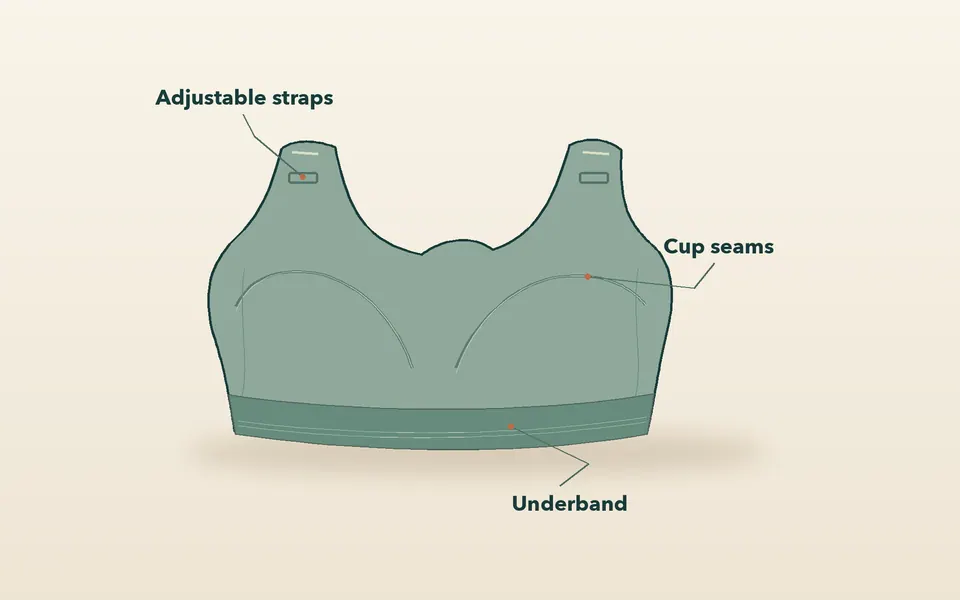
Brooks recommends a level, secure band; cups without overflow or unused space; and straps that neither slip nor dig in. Use those as distinct checks rather than judging only how tight the whole bra feels.
| Area | What to look at during a clean fitting | What to record if it fails |
|---|---|---|
| Band | Its position at the front and back, including after raising your arms | Where it moves, folds or feels uncomfortable |
| Cups or front panel | Coverage and whether the fabric or inserts sit as intended | Gaping, overflow, shifting inserts or an edge that presses |
| Straps | Their position and whether you can reach the adjusters | Slipping, an uncomfortable edge or no useful adjustment left |
| Fastening | Whether you can close, release and cover it as designed | A difficult hook, exposed fastening or awkward reach |
| Seams and edges | The underarm, band and strap contact points | The exact spot you keep noticing or rearranging |
Make one adjustment, repeat the check, then decide whether a different size or style is needed. Do not keep tightening straps to compensate for a problem elsewhere. Persistent discomfort is a reason to stop the fitting and seek another option, not something to prove you can tolerate.
Match the fitting to the intended activity
The Nike guide recommends raising the arms to check band position and moving in the bra to assess support. Its light, medium and high categories are manufacturer descriptions; use the intended activity on the actual product page as a shortlist, not a guarantee of fit.
Choose a few movements you ordinarily perform comfortably: reaching overhead, leaning forward or taking a few steps. If appropriate for your planned activity and fitting space, include its characteristic movement. You do not need a strenuous workout to notice a fastening you cannot reach or a strap that repeatedly slips.
Try the intended top as well. Check whether its neckline, armholes or seams interfere with the bra, and whether you are comfortable with the coverage when bending. If comparing two styles, use the same clothing and movements so that you can describe what changed.
Write observations rather than a single score: “band moved when I reached,” “cup edge pressed when seated,” or “could not release the back hook.” These are prompts for your own fitting notes, not results from a Coolkeel wear test.
Include getting changed in the decision
Try putting the bra on and taking it off during the permitted fitting. If a pullover is awkward, Brooks suggests considering an adjustable back closure or zip-front design. Check the actual fastening yourself; a different opening may introduce a different difficulty.
Think through where you will change after the session. Can you reach the closure, keep the rest of your outfit in place and pack the garment separately from clean clothing? A dry fitting cannot establish how easily that model will come off after exercise, so keep that uncertainty in the decision.
Make the keep-or-return decision before washing
Record the model, size, adjustment settings, intended activity and any unresolved fit issue. Check the seller’s conditions before removing tags, washing or exercising in it. The return-checklist guide explains how to separate a fitting from a permitted trial.
If you keep it, use its own care instructions, including directions for removable pads and fastenings. Recheck fit when the garment or your measurements change. Fiber names and moisture claims do not replace these checks; the fabric-claims guide explains what those labels can and cannot establish.
Questions and answers
Can I use the same tape measurements in every brand's calculator?
Only if the requested measurements are the same. Brooks describes a full-bust circumference, while Nike's reviewed guide uses a center-to-side measurement for its cup step. Follow one brand's complete method and the chart for the exact range.
Should I tighten the straps if the cups feel loose?
Check the cups and band separately first. Tightening straps alone does not establish that the size is right. Recheck the chart or ask a fitter if the cups gap, spill or shift while the band otherwise feels comfortable.
Does a high-support label guarantee the bra will suit running?
No. Use the maker's activity guidance to shortlist a style, then check your own fit and intended movements. A support label does not establish that the band, cups, straps or closure work for your body.
Can I wash a new bra before deciding whether to return it?
Check the seller's exact return conditions first. A clean fitting, washing and a sweaty workout can be treated differently. Follow the garment's care label if you keep it; do not assume all sports bras permit the same washing or drying method.