Moving · scenario
What to Wear to the Gym When You Have Hot Flashes
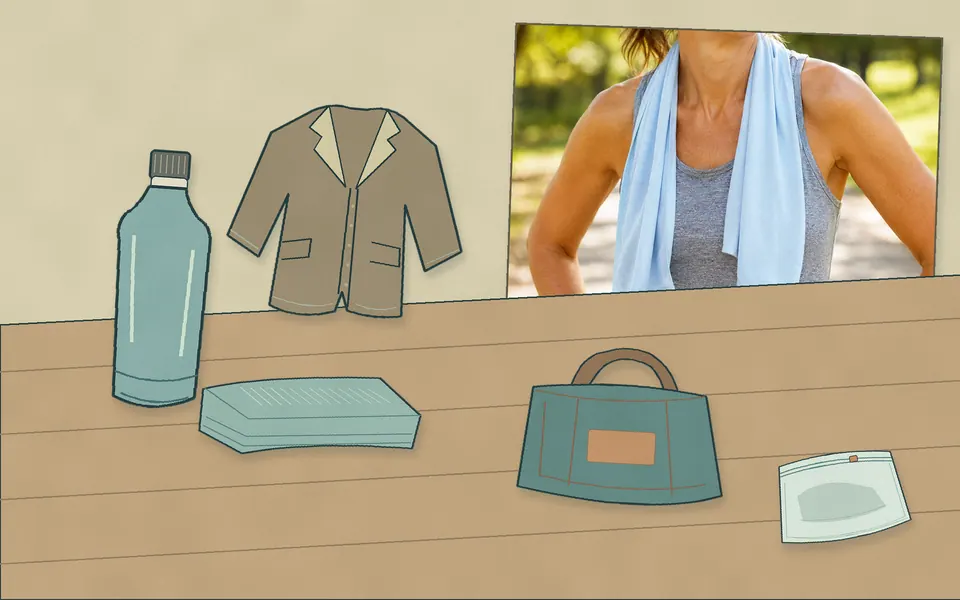
Build your gym outfit around a base you can exercise in on its own, the support your activity requires and an outer layer you can remove easily. Pack a dry change if you dislike traveling home in workout clothes. You do not need to replace your whole wardrobe before trying this arrangement.
Clothes can make adjustments easier. They cannot tell you whether sudden warmth, sweating or dizziness comes from a familiar hot flash, exertion or another cause.
Choose the base by movement, not the fabric slogan
Start with a top and bottoms you already find comfortable, or try a new outfit through the movements you plan to do. Reach overhead, bend, sit and check any position that usually makes clothing shift. Decide whether you are comfortable wearing the base without its jacket.
Keep the bra support, footwear and protective clothing your activity calls for. A loose top may suit one workout and interfere with another. Follow equipment and class instructions about loose fabric and accessories.
Do not use cotton, polyester, nylon or rayon as an automatic pass or fail. A fiber label is not a test of the finished garment. Check seams, lining, fit and how the item feels during your own use before buying duplicates. For practical label questions, use the fabric care checklist.
Match the setup to the workout
| Your session | An outfit or bag check |
|---|---|
| Seated machines or weights | Can you move freely without rearranging a hem or strap between repetitions? |
| A class with frequent position changes | Does the base provide the coverage you want when bending or reaching? |
| A cool journey followed by a warm room | Can the travel layer come off and fit in your bag or locker? |
| Outdoor exercise in hot weather | Could you change the time or location, as well as your clothes? |
| A workout followed by errands | Is the dry change accessible, with somewhere suitable to change? |
For exercise in hot weather, the CDC recommends choosing cooler times of day, pacing activity and having enough water. Its heat guidance is not a test for identifying menopause symptoms. Check the conditions rather than assuming an accessory makes a hot environment suitable for your planned session.
Decide how to pause before you start
Find the stopping controls on equipment and a place to rest. Put water where the venue allows it. If you are taking a class, ask how to step out without obstructing others. You can say, “I may need a break; where is the best place to pause?”
If you become uncomfortable, stop the movement safely: secure a weight or bring a machine to a stop using its controls before stepping away. Move to a suitable rest area and tell staff if you feel unwell. An optional fan or clothing adjustment is not a reason to ignore symptoms.
If you feel faint or weak during exercise in heat, stop all activity and get to a cool place, as the CDC advises. Seek medical help for suspected heat illness. Confusion or loss of consciousness after heat exposure needs emergency help; call 911 in the U.S. CDC heat-illness signs
There is no automatic “resume after two minutes” rule. Do not decide to continue just because a timer has finished or your shirt feels cooler.
Make the change home manageable
Pack according to what you actually want to replace: perhaps a top, or underwear and a full outfit. Keep clean clothes separate from worn items. Take everything out of the bag at home and follow the care instructions instead of leaving a damp towel packed for the next session.
If you want to bring a cooling towel, check its preparation and cleaning routine first; the cooling-towel guide explains the questions to ask. It is optional equipment, not a measure of whether you are safe to exercise.
For recurring symptoms that are interrupting activity, discuss them with a clinician. The NHS encourages getting advice about menopause symptoms and the available options; you do not need to solve the problem through clothing alone.
Questions and answers
Is cotton always the wrong fabric for a hot-flash workout?
Check the actual garment's fit, feel and care instructions. A fiber name alone does not establish how the finished item will suit your workout.
Should I choose a less supportive bra to stay cooler?
Keep the support your activity requires. Check the complete outfit while moving; a cooling claim is not a reason to discard support or protection.
Can I resume exercising after a short cooling break?
There is no fixed restart time. Stop and get help if you feel unwell. Faintness or weakness during exercise in heat needs particular attention.
What should go in my bag for after the workout?
Pack your preferred dry change and a separate bag for worn items. Unpack at home, then wash and dry according to the care instructions.