The 3 a.m. · trust gap
Wicking, Quick-Drying and Cool-to-Touch: Read the Test
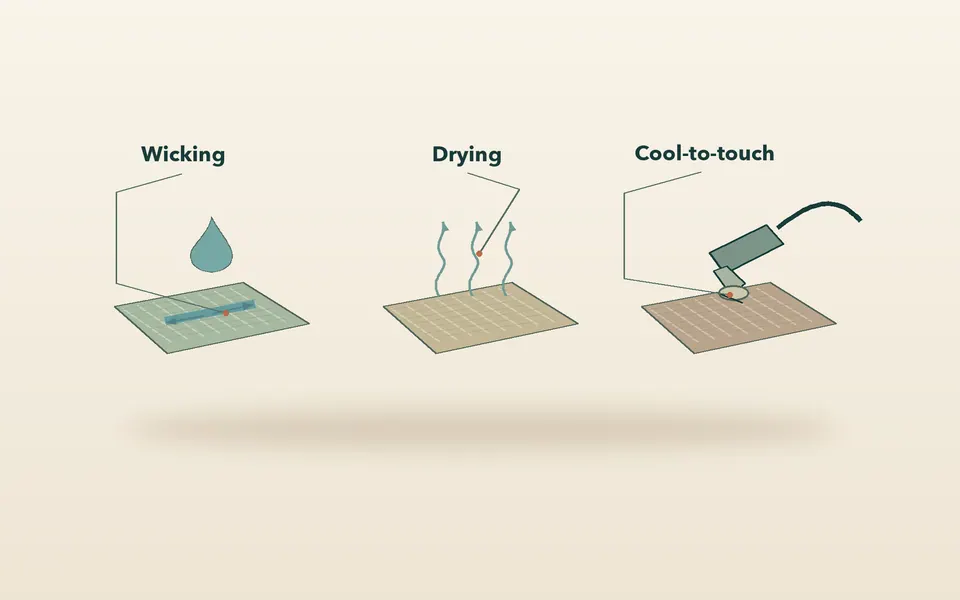
Wicking describes liquid moving through or along a textile. Drying concerns liquid leaving it. Cool-to-touch concerns the thermal sensation at contact. A result for one property does not answer all three questions.
Before paying more for a performance claim, match the test to the problem you want the item to solve. This guide explains public method descriptions and how to question a report; it does not present tests of any product.
Match the claim to a measurement
| Claim | Relevant measurement | What to look for in a report | What remains unanswered |
|---|---|---|---|
| Moisture-wicking | Movement of liquid along or through a specimen | Direction, distance or timing endpoint, method and units | When the item becomes dry; how it feels while worn |
| Quick-drying | Drying time or rate under specified conditions | Starting water condition, heat and airflow conditions, endpoint and comparison | When a whole garment will dry in your room |
| Cool-to-touch | Initial contact heat transfer, assessed by a named method | Measured quantity, units, sample condition and contact setup | How long the sensation lasts; whether the item suits a whole night |
The method examples below explain why those report fields matter. They are not the only possible tests, and this checklist is not a laboratory procedure.
Read the endpoint before the number
For wicking, check where the liquid went and when it was measured. AATCC TM197-2022 evaluates vertically positioned textiles and uses specified distances. TM213-2022 follows liquid rising from a submerged cut edge over specified times. AATCC separated those approaches in its 2022 method revision. A screenshot saying only “vertical wicking” leaves the endpoint unclear. Ask for the method edition, measured direction and result definition before ranking it against another report.
For drying, check how the sample started wet and how it was dried. AATCC TM200 examines drying at the textile’s absorbent capacity. TM201 uses a prescribed water amount with the fabric on a heated plate. These are different setups. Request the starting water condition, temperature, airflow and definition of completion used in the actual report. A shorter time from a different setup is not enough to declare one garment faster for your laundry routine.
For contact feel, identify the quantity instead of looking for the largest number. ASTM D7984-21 measures thermal effusivity and relates it to initial contact warmth or coolness. Its stated scope uses dry fabrics in ambient conditions. Separately, instrument maker KATO TECH explains qmax as peak heat flux used to evaluate contact feel. qmax and thermal effusivity are different quantities, not interchangeable cooling scores. Neither result alone establishes an all-night effect or behavior after the fabric becomes wet.
Check whether the report belongs to your item
Use this as a buyer’s request list, not a claim that every standard mandates every field below. A missing field is a question to resolve, not proof that a product performs badly.
| Check | Information to request | Decision it helps you make |
|---|---|---|
| Traceability | Laboratory name, report number and test date | Can the seller supply an identifiable report rather than a detached score? |
| Sample identity | Style or fabric code, composition, construction, finish and tested side | Does the result describe the material in your chosen item? |
| Method | Standard number, edition, selected option and any departures | Were the competing items tested the same way? |
| Result | Measured quantity, units, number of specimens, individual results or reported variation | Is the comparison more informative than one unexplained average? |
| Conditions | Relevant temperature, humidity, water preparation, airflow and contact setup | Are the conditions sufficiently matched to compare the results? |
| Washing history | Unwashed or washed; cycle count, wash and drying procedure | Does the evidence address the durability claim you care about? |
| Comparison or pass claim | Named reference sample, acceptance criterion and who set it | What does “better” or “pass” mean in this report? |
If a supplier tested a fabric swatch, ask how its code maps to the current garment. Keep lining, fit and seams as separate buying checks. A report about the fabric does not answer whether the waistband or cut suits you.
For example, suppose one listing provides a drying result for an unwashed fabric under TM200, while another provides a result after washing under TM201. You cannot isolate which fabric dries faster from that pair of results. The method and sample history both differ. Request a matched comparison, or leave the performance ranking unknown. This is an illustration, not product test data.
Choose the evidence for your situation
- You want a pleasant first touch from a pillowcase. Contact-feel evidence is relevant. Check that the tested face is the one you will use. Keep a claim about first contact separate from a claim about hours in bed.
- Your clothing feels unpleasant once damp. Ask about liquid movement and drying separately. A vertical wicking result alone does not tell you whether moisture moves from the skin-facing side to the outside of the finished garment. Fit and wet feel still need a permitted personal trial.
- You need travel clothing to be ready after washing. Prioritize care requirements and drying evidence. Do not turn a heated-plate result into an overnight drying promise. Plan a spare if your trip depends on having a dry change.
- You will wash the item frequently. Request evidence for the claimed wash history and compare the procedure with the supplied care label. Do not assume an unwashed score lasts indefinitely.
These are editorial ways to prioritize questions. They do not establish sleep benefits or rank products. For choosing an actual pair, use the cooling-pajama buying guide; for a workable laundry routine, use the care-label checklist.
A message you can send the seller
I am considering this exact style and variant. Could you share the relevant test report or a readable extract identifying the sample, laboratory, date, method and edition? Please include the result and units, test conditions, and whether it was tested before or after washing. If you describe it as better or as passing, what reference or acceptance criterion was used? My main concern is [liquid movement / drying after washing / first-touch feel]. Which result addresses that concern?
If the seller cannot provide that information, record the performance claim as unverified. You can still choose an item for a known fit, texture, practical care routine or suitable return terms. Keep the uncertainty visible instead of treating a test logo, price or fiber name as the missing evidence.
Questions and answers
Does moisture-wicking mean a garment will dry quickly?
A wicking result measures liquid movement under the chosen test conditions. It does not supply a drying time. Ask for separate drying evidence, including the starting water condition and the method used.
Can I compare qmax directly with thermal effusivity?
No. They are different measured quantities used to examine aspects of contact heat transfer. Keep the method, units and conditions attached to each result; do not rank their numerical values on one cooling scale.
What does a test result marked pass actually tell me?
Ask which requirement the sample passed, who set that requirement, and which result was compared with it. A method number without the result and acceptance criterion is not enough to judge the claim.
Does an unwashed fabric test support a claim about repeated washing?
It does not establish performance after your laundry routine. Ask for results after a stated number of wash and dry cycles, the procedure used, and confirmation that the sample matches the item you want.