The 3 a.m. · comparison
Knit vs Woven Cotton Pajamas: Compare the Actual Garments
When two pajama sets both say 100% cotton, compare the actual garments in four ways: fabric construction, room to move, openings and seams, and care. Choose against a specific problem—sleeves pulling when you turn, a waistband pressing when seated, or nowhere to dry clothes flat. The fiber label cannot settle those decisions.
This guide uses two manufacturer-documented examples checked on October 1, 2026. We have not worn or tested either set.
What changes when the fiber stays the same?
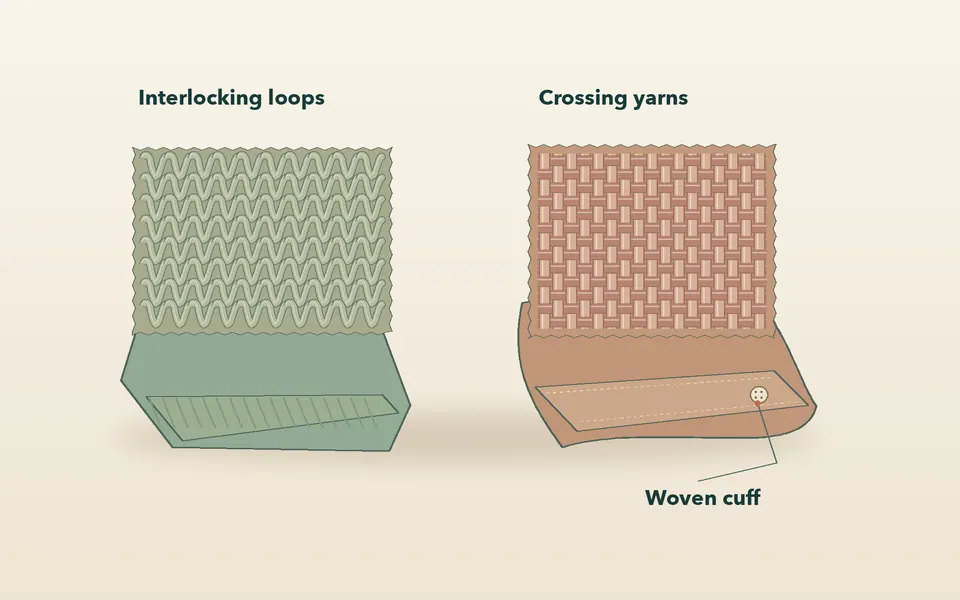
CottonWorks defines knitting as forming fabric through connected yarn loops. In weaving, lengthwise and crosswise yarns interlace. These terms describe how the fabric is built; neither specifies the finished garment’s dimensions or provides a cooling score.
For a concrete comparison, LAKE lists both of the following shorts sets as 100% Pima cotton:
| Check | Pima Long-Short Set in Hydrangea | Charlie Shorts Set in Eden Seersucker |
|---|---|---|
| Construction stated by LAKE | Knit | Woven seersucker with a puckered surface |
| Top details | Scoop neckline; three-quarter sleeves | Deep scoop neckline; gathered sleeves; full button opening |
| Shorts details | Elastic waistband; 3-inch inseam | Elastic waistband; curved hems; 3-inch inseam |
| Care instructions | Cold machine wash on delicate with mild soap; dry flat | Cold machine wash on delicate with mild soap; dry flat |
Sources: LAKE’s Hydrangea set and Eden Seersucker set. Check the complete instructions and the label on the garment you receive.
The useful contrast is that matching fiber descriptions and shorts inseams still leave different surfaces, sleeves and openings. This is not a controlled fabric comparison: yarn details, fabric weight and finishes are not established as equal. The pages do not provide comparable thermal results or measured stretch and recovery. Their comfort descriptions cannot identify which set will feel better on you.
Build a comparison around one garment that already fits
Pick pajamas you own whose fit you like. Lay them flat without pulling the fabric and record the top’s underarm width and length, sleeve length, and the bottoms’ waist, rise and inseam. Note which measurements were taken flat rather than around the garment.
Ask the seller for the same finished-garment measurements in your proposed size. A chart of body bust, waist and hip measurements is not automatically a chart of garment dimensions. If the seller supplies only body measurements, leave the garment comparison unresolved rather than assuming two size labels contain the same room.
Use this checklist before deciding:
| Your recurring problem | What to compare on each actual garment | What remains to check in person |
|---|---|---|
| The top pulls when you reach or turn | Underarm width, sleeve shape and length | Reach forward and lift your arms gently; notice pulling or the hem riding up |
| Shorts feel restrictive while seated | Rise, hip room, waistband design and leg opening | Sit and bend your knees; check pressure at the waist, seat and thighs |
| Changing clothes is awkward | Neck opening and any buttons or other fasteners | Try the opening with your normal range of movement; check whether you can manage the fasteners |
| A seam or textured surface bothers you | Seam locations, labels and fabric close-ups | Feel those areas against your skin during a permitted try-on |
These are practical fit checks, not laboratory tests. Follow the retailer’s try-on and return conditions. Avoid stretching the fabric forcefully to see how far it goes; that does not establish how it will recover during repeated wear.
Let the care requirement eliminate unsuitable choices
For the two examples above, care is a shared constraint: both say to dry flat. If your routine requires tumble drying, look for another garment with instructions that permit it. Do not choose between these two on an assumed knit-versus-woven drying advantage.
LAKE also warns of first-wash shrinkage, especially in length, for the Hydrangea Pima set. It does not provide a numeric shrinkage allowance for you to calculate. Ask about the intended new fit and any available washed-garment measurements before changing size. Once you decide to keep a garment, follow its label and compare the same measurements after laundering; record what happened to your item without generalizing to all cotton.
Make the decision using the information you have
Write one sentence for each candidate: “This addresses my ___ problem because ___ is confirmed; ___ is still unknown.” A documented button opening may answer a dressing preference. A confirmed garment dimension may answer a fit concern. Neither answers whether a fabric will keep you cooler overnight.
If cooling performance is the deciding factor, use the separate wicking, drying and cool-touch claims checklist to ask for evidence relevant to that claim. If the compositions also differ, use the fiber-label comparison alongside this garment checklist. Keep the final choice tied to a feature you can verify and a care routine you can follow.
Questions and answers
Are knit and woven different fibers?
No. They describe fabric construction. Knitting forms connected yarn loops; weaving crosses sets of yarns. Either construction can use cotton, so a cotton label alone does not identify the structure.
Does a knit garment necessarily contain elastane?
No. The LAKE knit example reviewed here is listed as 100% Pima cotton. Check the composition of the exact item; the word knit does not establish added elastane or a measured amount of stretch and recovery.
Which is cooler: knit or woven cotton pajamas?
These two product descriptions do not establish a cooler winner. They describe different constructions and garment designs, without comparable thermal test results. Use fit, coverage, openings and care to narrow the choice, and keep cooling performance unverified.
Can I use the same drying method for all cotton pajamas?
No. Follow the instructions for the exact garment. Both examples in this guide specify drying flat, so neither product description supports substituting tumble drying simply because the fiber is cotton.