Moving · process
Long Hair and Neck Fans: Check the Inlets Before Wearing One
Before wearing a neck fan with long hair, match the unit to its manual, locate every air inlet, read the hair and clothing warnings, and check the proposed arrangement with the power off. If the instructions are missing or you cannot keep hair and clothing clear as required, leave the fan off and choose another arrangement.
A smooth housing, a concealed opening or a “bladeless” label is not enough to answer the question. What matters is where air enters this particular device and what its manufacturer requires of the wearer.
Start with the model, not the listing photograph
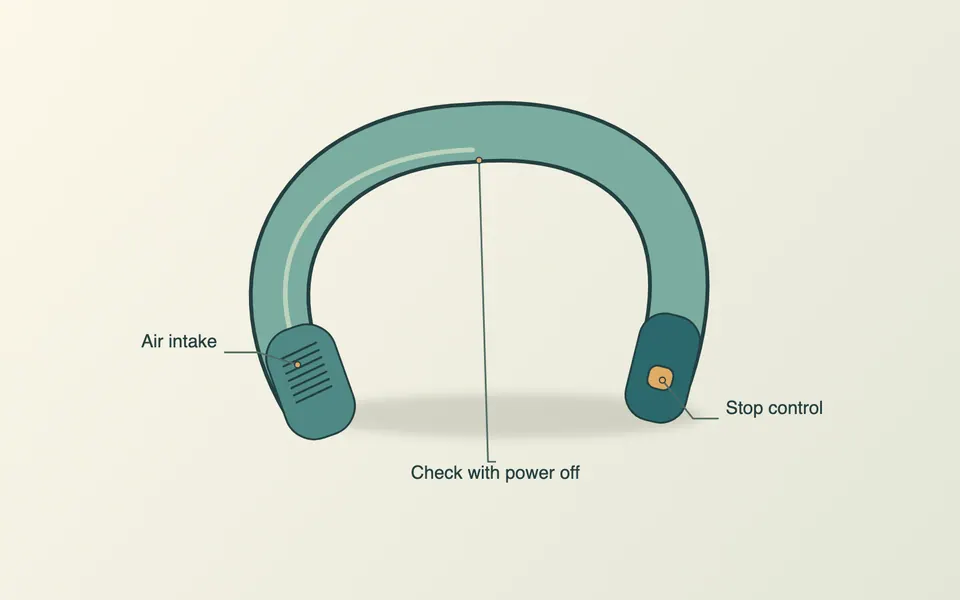
Record the model on the unit or packaging and obtain the complete manual for the version sold in your market. Compare its diagram with the actual device: openings, buttons and charging port should be identifiable. Ask the manufacturer to resolve a mismatch before use.
The examples below come from the English sections currently linked through JISULIFE’s official support page, checked October 5, 2026. They illustrate how to read instructions, not a product recommendation or a safety comparison. Regional applicability and your unit’s revision still need checking.
| Manual examined | What to locate and resolve |
|---|---|
| Neck Fan Pro1, linked under FNP01 | Printed page 01 labels the inlets 1 and outlets 2. Page 07 includes a long-hair precaution and forbids covering the openings. |
| Neck Fan Life3, model FA14 | Printed page 01 labels the inlets 4 and outlet 1. The support link is headed FNL03, but the PDF identifies FA14: verify that match for your unit. |
Read every view of the diagram. One numbered inlet label may point to several locations; do not check only the most obvious grille. The drawings identify openings, but do not establish how well a guard excludes hair.
Separate a design claim from a wearing instruction
The Pro1 product page markets its concealed intake as preventing tangles. Its manual nevertheless tells long-haired users to secure or separate their hair from the intake. Use the manual’s precaution; the marketing statement does not remove it.
The reviewed FA14 English safety section prohibits obstructing the openings but contains no specific long-hair instruction. That omission does not establish permission to wear it with loose hair. Ask the maker how that model is intended to be used with your hairstyle before selecting it for this purpose.
Neither reviewed English manual gives a numerical hair-clearance distance or a named hairstyle that guarantees suitability. We have not worn, tested or compared these fans.
Do an off-power fit check
This is a practical way to identify an unsuitable arrangement before starting the fan; it is not a test that certifies safety.
- Check condition first. Both manuals require checking the product and cord for damage before powering on. Resolve damaged housings, openings or controls with the seller or manufacturer; do not repair the grille yourself.
- Use the intended orientation. Both wearing diagrams show the outlet facing upward. Follow the matching diagram rather than reversing the device to accommodate hair.
- Arrange hair before wearing it. With the fan off, identify loose ends at the back, sides and around your face. Use a mirror or ask someone to help locate openings you cannot see. A ponytail can still leave ends near an inlet; check their actual position.
- Include what you will wear. Check the collar, scarf, lanyard and any towel around your neck. In these manuals, fabric must not cover the air openings. Do not tuck an operating fan underneath clothing to hide it.
- Check ordinary movement while it remains off. Turn your head and look down as you would at your desk or on a walk. If hair or fabric moves over an opening, change the arrangement or rule it out. Do not deliberately bring hair toward a running intake to see what happens.
Know the stop control before putting it on
The controls differ. Pro1’s printed page 03 describes a short press of its on/off key to switch off. FA14’s page 02 describes a long press of its power/speed button to stop directly; short presses cycle settings. Check your own manual and learn the control before wearing the fan.
Keep a simple decision rule: an unresolved fit or instruction problem means pause, not a higher-confidence guess.
| What you find | Next action |
|---|---|
| Manual, label or diagram does not match | Ask for the correct regional model instructions before use. |
| Hair or clothing cannot stay clear as directed | Leave the fan off; consider an option worn elsewhere or not worn at all. |
| You are considering added mesh or tape | Stop that plan. Both manuals prohibit modification; an improvised cover is not a verified guard. |
| The setup needs changing during use | Switch off before rearranging it, then repeat the off-power check. |
For a seller inquiry, give the exact model and ask: “Which manual applies to this unit, where are all its inlets, and what are its long-hair and clothing instructions?” Request a manual page reference rather than accepting “hair friendly” alone.
If wearable placement remains impractical, compare the space and preparation needed by a desk fan or another comfort tool. A different format still needs its own placement and use checks.
Questions and answers
Does a bladeless neck fan mean my hair cannot get caught?
Do not infer that from the label. Identify the air inlets and read the exact model's warnings. JISULIFE's Pro1 manual includes a long-hair precaution despite the product page's hidden-inlet marketing. This guide has not tested entanglement risk.
Is putting my hair in a ponytail enough?
A hairstyle name does not establish clearance. Check where the ends and loose strands sit relative to every inlet, including when you turn your head. Follow the matching manual; if you cannot maintain its required arrangement, do not wear the fan.
How many inches should I keep hair away from a neck fan?
No numerical hair-clearance distance was stated in the two English manuals reviewed here. Do not invent one or transfer a distance from another model. Ask the manufacturer about your exact unit if its instructions leave that question unresolved.
Can I add mesh or a fabric cover over the intake?
Do not improvise a guard or cover. The reviewed manuals prohibit modifications and obstructing the air openings. An unresolved hair or clothing conflict is a reason to pause and ask the manufacturer, not to redesign the fan.