At the Desk · process
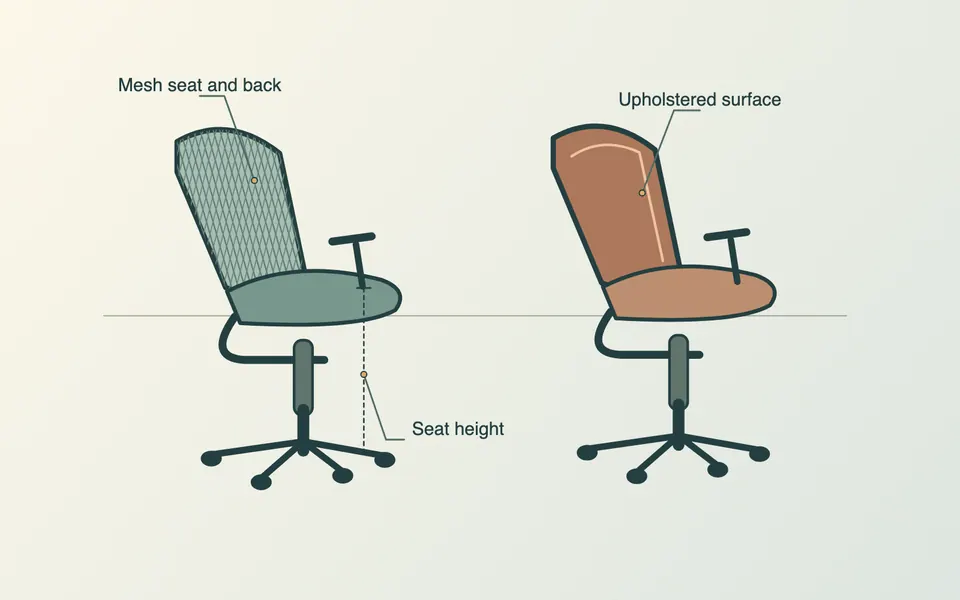
Mesh vs Padded Office Chair: A Fit-First Comparison for Warm Workdays
If an office chair feels too warm, separate the material question from the fit question. First record whether the heat is at the seat, back, clothing or room level. Then compare the exact chair configuration, its dimensions and adjustment range, the way you will clean it, and the return path that applies to your order. A mesh label is not a personal cooling test, and an upholstered chair is not automatically a fit failure.
This worksheet uses two current US direct-store configurations as concrete examples:
- Herman Miller Aeron, page SKU 100077477, size B shown: 8Z Pellicle suspension on the seat and back; the product page lists 41 in high, 27 in wide and 16¾ in deep, with a 16–20½ in seat-height range for the size-B specification. Verify the selected size and options in the order summary because Aeron is also sold in sizes A and C. Aeron product page
- Steelcase Leap Ready to Ship, SKU CN3CP5MY7BF8VM9HR5ZR: the US store labels this exact preconfigured model an upholstered office chair. The current Leap specification guide lists the upholstered seat/back configuration at 21¾–24¾ in overall depth, 27 in wide, 38½–43½ in high, 15½–20½ in seat height, and 15¾–18¾ in functional seat depth. Ready-to-Ship page · Leap specification guide
The Aeron page describes Pellicle as breathable. That is the manufacturer’s product description, not evidence that it will feel cooler for you. The comparison below does not rank either chair’s thermal performance.
1. Record the configuration before comparing it
Write down the store, country, page SKU, manufacturer SKU if shown, chair size, seat material, back material, frame/base, arms and casters. Take a screenshot of the order summary. Do not substitute a Leap Plus, stool or a different Aeron size because the name looks similar.
The two examples are not interchangeable. Keep these fields in separate notes:
- Aeron: record the A/B/C size, 8Z Pellicle seat and back, the size-B page’s 16–20½ in seat-height range and 16¾ in depth, plus seat height, tilt, arm and PostureFit controls.
- Leap Ready-to-Ship: record the selected upholstery, 15½–20½ in seat height, 15¾–18¾ in functional seat depth, lower-back and recline settings, and 4D arm adjustments.
- Unknown for both: no field above proves a cooler or warmer personal result.
Steelcase also lists a 3D Knit back with an upholstered seat as a separate option. Treat that as a third configuration. If an order shows 3D Knit, check whether it is on the back only before calling it a mesh-seat chair.
2. Check fit at the desk, not just the surface
OSHA’s chair guidance says to try different chairs before buying. Its practical checks are useful here: the whole foot should rest on the floor or a footrest, the seat should support the thighs without the knee touching the front edge, the backrest should support the lower back, and adjustable arms should let the shoulders relax without preventing the chair from moving close to the keyboard.
Use the same work setup for each chair and write down what you can change:
- Feet and seat height. Lower or raise the seat until your feet are supported and the desk remains usable. If the chair is too high for the desk, note whether a footrest is an acceptable option for your setup.
- Seat depth. Sit back against the backrest. Check that the front edge does not press behind your knees while most of your thighs remain supported. Record the usable range, not only the advertised total depth.
- Back and recline. Try the back-support and recline settings you would use during typing, reading and a call. A setting that works only when the chair is pulled away from the desk is a desk-fit problem to resolve.
- Arms and keyboard. Move the arms through their available height, width, depth and pivot adjustments. Can the chair approach the desk without the arms colliding with its edge? OSHA notes that arms that are too wide or too high can interfere with positioning.
- Material location. Notice where your body contacts the seat and back. A ventilated back does not answer a warm-seat question; a fabric seat does not answer a warm-room question. Record the observation without turning it into a universal cooling claim.
3. Keep care specific to the surface
Do not copy care directions from another fabric or another chair. Save the exact care page with the order record.
- For the Aeron, use Herman Miller’s Aeron adjustment guide for the controls and follow the current manufacturer care instructions for the Pellicle and frame. Do not improvise a cleaner or claim that a particular cleaning routine makes the chair cooler.
- For the Leap upholstered configuration, Steelcase’s current Leap product information specifies a light mixture of one part clear dish soap to 16 parts water, without soaking, and says to avoid disinfectants. Follow the exact fabric instructions and allow the surface to dry as directed. Those care instructions describe cleaning; they do not establish a thermal result.
If a seller or manufacturer has not identified the fabric in your order, treat that as a confirmation task. Do not infer the material from a product photograph or from another Leap option.
4. Confirm the return route before a trial
A chair trial is only useful if you can keep the return option intact. Policies below are the current direct-store examples reviewed for this guide; a retailer, custom order, non-US address or changed policy can differ.
- Herman Miller US: the returns page says to report a return within 30 days, retain the packaging and return the item in original/like-new condition. Shipping and delivery are nonrefundable; performance seating has a $99 return-shipping fee, and the page says a 10% restocking fee can apply when the original packaging is unavailable. Check exclusions and the exact order terms before opening the package. Herman Miller returns
- Steelcase direct store, contiguous US: the current policy says ergonomic chairs including Leap and Ready-to-Ship can be returned within 30 days of delivery, with no return-shipping or restocking fee when returned new and without assembly damage. If the assembled chair no longer fits its original package, customer care can provide return packaging in the contiguous US. Alaska, Hawaii, Canada, retailers, custom products and special orders have different rules or exclusions. Steelcase returns
A return window is not permission to soak, stain or modify the chair. Keep the packaging, use an ordinary desk setup, document the settings you tried, and stop before assembly or use that would violate the policy.
5. Use a short, repeatable trial worksheet
For each chair, record the date, exact configuration and work tasks. Try the same keyboard height, desk edge, clothing layer and ordinary call or reading task. Ask only questions you can answer from this setup:
| Observation | Keep testing when… | Pause and verify when… |
|---|---|---|
| Seat height/depth | Feet, desk and knee clearance work together | You cannot support your feet or the seat edge contacts your knees |
| Arms/desk | Arms support your lower arms without blocking the desk | You must pull the chair away or raise your shoulders |
| Back/recline | You can work and recline in the settings you expect to use | Support depends on an unverified size or option |
| Surface/care | Material and care instructions match the order | The listing does not identify the surface or your cleaner is not permitted |
| Return | Packaging and seller conditions are recorded | The seller, region or custom status is unclear |
At the end, choose one action: keep testing, confirm a configuration or policy, or hold the purchase. “Feels cooler” can be a useful observation for your own setup, but it is not a product-wide result.
Questions to resolve before checkout
- Is the warmth at the seat, back, clothing or room? What will this chair actually change?
- Which exact size and surface are in the order summary?
- Can the seat height and usable depth fit your desk and leg clearance?
- Can the arms clear the desk while your shoulders stay relaxed?
- What care product and drying method does this exact surface allow?
- Which seller’s return policy applies, and can you retain the packaging?
This guide is about choosing and trying an office chair. It does not diagnose pain, circulation problems or a medical condition. If discomfort or symptoms persist, use an appropriate professional channel rather than treating chair material as a diagnosis.
Questions and answers
Is mesh automatically cooler than a padded office chair?
No universal cooling result follows from the word mesh. In this comparison Herman Miller describes the Aeron's 8Z Pellicle suspension as breathable, while Steelcase labels the selected Leap Ready-to-Ship configuration upholstered. Those descriptions identify surfaces; they are not a head-to-head thermal test for your room, clothing or work pattern.
Is the Steelcase Leap 3D Knit version a mesh-seat comparison?
No. Steelcase's specification guide lists 3D Knit on the back with upholstery on the seat as a separate configuration. Confirm the order summary: a mesh-like back does not make the seat a mesh seat.
Does a 30-day return window mean I can wet or heavily test a chair?
No. A time window and the seller's condition, packaging and fee rules are separate. Keep packaging, use the chair for ordinary fit checks, and read the current policy for the exact seller and region before ordering.
Which chair fits my body?
This guide cannot prescribe a chair. Record the exact size and configuration, compare the seat height and usable depth with your desk and legs, and try the adjustments in your ordinary tasks. OSHA recommends trying different chairs before purchase.