The 3 a.m. · process
Bedroom Fan Checklist: Placement, Controls and Cleaning
For a rented bedroom, choose a usable fan position before choosing a model. Check the base footprint, power route, access from bed and cleaning instructions. Then compare the setting you would use, including its lights, beeps and automatic changes.
This guide covers movable fans without drilling or fixed wiring. It helps you assess a setup; it does not promise a cooler room, better sleep or fewer night sweats. No fans were tested for this guide.
Draw the bedside layout first
Mark three things on a simple room sketch: the outlet, the possible fan position and your route from bed to the door. Include the route to the bathroom and any drawers that must open. The CPSC’s portable-fan safety advice emphasizes secure placement and keeping cords out of foot traffic.
Consider two possible layouts:
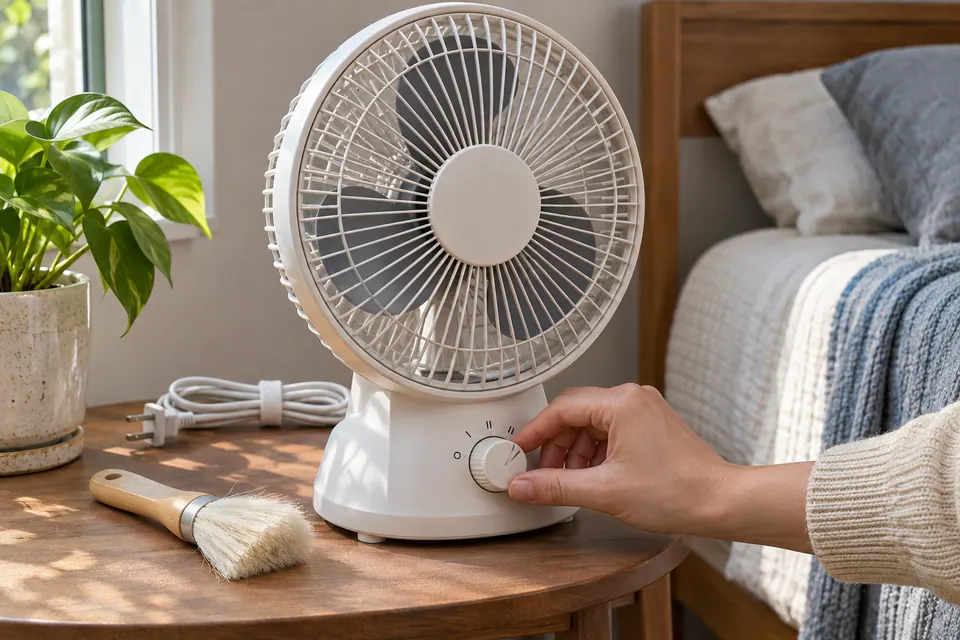
- Beside the bed on a table: only if the model permits tabletop use and its whole base fits on a stable surface. Leave room for the controls and the specified clearances. Keep bedding and curtains away; do not balance it on stacked books or put it on the mattress.
- On the floor beside an outlet: only if floor placement is permitted and the assembled base leaves the walking route clear. Check the fan’s air-outlet height relative to your mattress: a low fan aimed into the side of the bed may not suit the position you planned. Do not raise a floor-only model onto furniture to solve that problem.
Before buying, use a piece of cardboard to represent the published base dimensions and check doors, drawers and walking space. Remove it before operating the fan. Allow for the full movement of an oscillating model, following its instructions.
Keep the cord clear of rugs, furniture legs and walkways. If a position depends on a permanent extension-cord arrangement, choose another position or resolve the power provision with the property manager. The CPSC home electrical checklist identifies these cord hazards and advises moving an appliance nearer an outlet rather than permanently relying on an extension.
Use a buyer’s comparison sheet
Complete this for each exact model and regional version. A missing answer remains unknown.
| Field to compare | What to record | Reason to pause |
|---|---|---|
| Position and size | Permitted surface, assembled base width/depth, height and required clearances | The base fits only by blocking a route or crowding fabric |
| Power | Supply required on the rating label and a workable cord route | The proposed supply or placement conflicts with the instructions |
| Bedside controls | Physical controls, remote, display-off and beep options | Switching off requires an awkward reach or getting around the fan |
| Automatic behavior | What timer, Sleep and Auto actually change | The mode changes airflow in a way you do not want |
| Sound | Stated setting, test conditions and whether oscillation is included | A quiet claim has no comparable measurement details |
| Cleaning | Accessible surfaces, tools needed and permitted grille removal | You cannot perform the described routine or obtain clear instructions |
Two official examples show how control information can differ. The Vornado 460 page describes a three-speed knob and adjustable tilt. Dreo’s Nomad One standard support page, which lists DR-HTF007 among its models, describes remote operation, screen-off options and a Sleep mode that reduces speed over time and silences prompts.
These details, checked September 30, 2026, help identify what to ask. They do not establish which fan is quieter or more comfortable. Comparable acoustic test conditions were not established from the reviewed sources.
Rehearse the night controls while awake
With the fan set up according to its manual, check whether you can find the off control from your normal bed position. If using a remote, choose a reachable storage spot. Check what happens to the display and any confirmation beep when you change a setting.
Try the intended speed, then oscillation if you plan to use it. Listen from the bed; include the other pillow position if sharing. Note airflow sound, hum, rattling or movement noise separately. A personal listening check can tell you what you prefer, but it is not a calibrated decibel test.
Read restrictions on unattended operation before planning nighttime use. A timer only performs its stated function. Do not assume a Sleep label approves every placement or operating routine.
Check cleaning and condition before use
Read the cleaning instructions before buying. For example, the Vornado 460 Use & Care guide describes vacuum-brush cleaning of the grille and inlets, and a four-screw grille-removal procedure after unplugging. That shows a maintenance requirement worth checking; it is not permission to open another model. Dreo’s cleaning disassembly procedure was not verified for this comparison.
Before use, check the exact model and identifying details against CPSC recalls, inspect the cord and base, and confirm that the guards and required parts are properly fitted. Follow the manufacturer when switching off, unplugging, repositioning and cleaning. Stop using damaged equipment and arrange the appropriate repair or replacement.
If the setup crowds your dry clothing or bedside supplies, adjust the layout before adding more equipment. The nighttime change-kit guide covers those supplies; the separate-bedding guide covers differences in preferred bed coverings.
Questions and answers
Is a tower fan better than a tabletop fan beside the bed?
Choose by the usable space and the model's placement instructions. A tower needs a stable floor position and clear walking route; a tabletop model needs a suitable surface with room for its base, cord and required clearances. Neither shape is automatically better.
How far should a fan be from the bed?
Use the manufacturer's clearances and keep bedding, curtains and the walking route clear. This guide does not set one distance or airflow direction for every fan, bed height and room. Adjust only within the permitted setup.
Does a lower advertised decibel number mean a quieter bedroom fan?
First compare the speed, measurement distance and test conditions behind each number. Without comparable information, leave the comparison unresolved. Also check control beeps, oscillation and whether the intended setting is comfortable to listen to from the bed.
Does sleep mode mean the fan keeps the same speed all night?
Read the exact model's instructions. Sleep mode may change speed, display lighting or control sounds. Check the behavior before relying on it, and follow any restrictions on unattended operation; a timer or sleep button is not blanket permission for overnight use.