The 3 a.m. · process
Will a Window Fan Fit? Check Sash Movement, Orientation and Extenders
A window fan fits only when its instructions permit your window type, its orientation and the complete mounting arrangement. A housing that can be placed in the opening is not enough. In particular, a window sash moving sideways does not automatically mean a fan may be stood on its end.
Before comparing airflow or controls, make a fit record for the exact window and fan. This guide uses two manufacturer documents to show common reasons to stop a purchase. It does not rate cooling performance or provide an alternative to the complete installation instructions.
Describe the window before searching for a fan
Avoid relying on the phrase “horizontal window,” which can be misunderstood. Record what you can see:
- Sash movement: one part slides up and down, one part slides sideways, or the sash swings outward or inward.
- Clear opening: measure the unobstructed width and height with the window in the position needed for use.
- Mounting surfaces: note the sill, frame steps, handles, locks and tracks that could meet the fan or its retaining pieces.
- Other fittings: record a screen, existing blind, curtains and any window restrictor. Do not assume these can be removed.
- Access: identify how the window must continue to open and close, and whether it is part of the household’s escape plan. Resolve any conflict before installing an appliance.
Take measurements where the completed assembly would sit, rather than using the glass dimensions or a room listing’s approximate window size. If you rent, confirm the permitted installation with the property manager.
Example 1: TRANSOM’s orientation is a firm stop
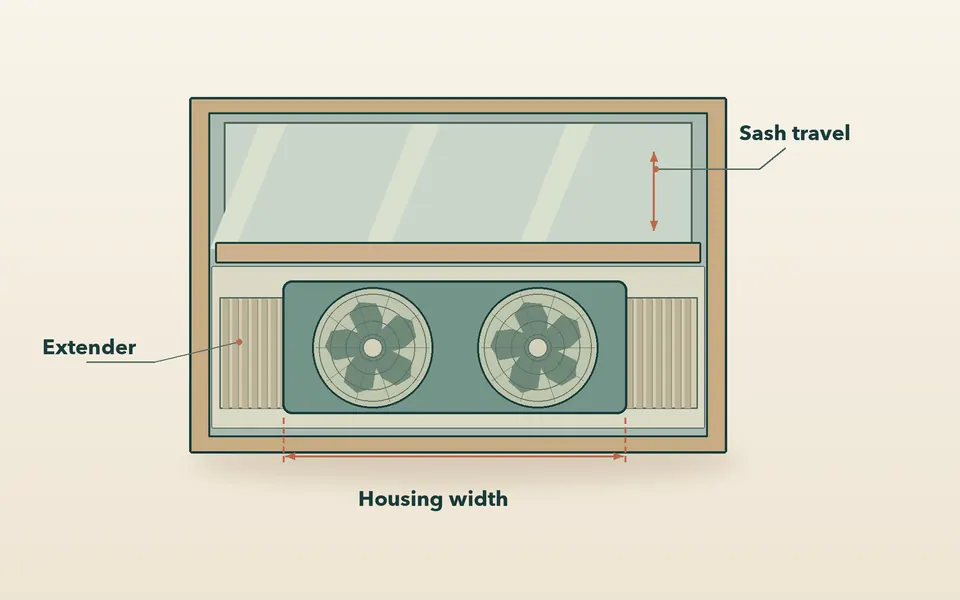
Vornado’s current TRANSOM Use & Care guide specifies single-hung or double-hung windows, a 26–40-inch width range and horizontal installation only. Its diagram shows the fan secured by closing the sash above it, with the specified foam pieces completing the fit. It explicitly excludes vertical installation. A side-opening window that would require standing this fan on end therefore fails this documented installation method. Vornado TRANSOM guide, printed page 8
There is also a dimension conflict to resolve: the linked guide states at least 8 inches of opening height, while the manufacturer’s product-page answer states 10 inches of minimum clearance. Both were checked on November 4, 2026. If your decision depends on that difference, ask Vornado to confirm the requirement for the exact unit before buying. The smaller figure is not a confirmed permission to proceed. Vornado TRANSOM product page
Keep the model distinction intact. Instructions for another Vornado model, including a similarly named version, do not settle the question for this unit. Nor does an example photo of a different installation override the applicable manual.
Example 2: permitted vertical installation still has a size limit
Bionaire’s manufacturer-hosted leaflet for BWF0522M / BWF0502M includes a vertical installation section. It specifies the rigid extender at the base, the fan’s left side at the bottom and its built-in extender at the top. Figure 1 labels the total extendible span as 36.7 inches (93.2 cm). This is a historical leaflet with a 2012 copyright and 2013 layout date; it does not establish present availability or parts support. Bionaire instruction leaflet, English installation section and Figure 1
For a 45-inch opening along the required mounting span, 36.7 inches is insufficient. That is a comparison of the stated dimensions, not a hands-on fit test. Permission to orient a fan vertically does not make its extensions unlimited. Do not treat additional homemade filler or a second appliance as an approved way to bridge the difference.
The useful result may be “neither of these documented arrangements fits my window.” That saves a mistaken purchase. It is not necessary to nominate a winner when the dimensions or support method rule both examples out.
Complete a fit card for the model you are considering
Use the following fields before checkout. Keep unknowns visible rather than replacing them with an assumption from a listing image.
| Field | Your record | What stops the purchase |
|---|---|---|
| Exact model and market | Model suffix, seller region and manual revision | Only a similar name or different-region document is available |
| Window and orientation | Sash movement plus the fan’s permitted position | Your proposed position is excluded or not described |
| Supported opening | Your measurements beside the specified installation range | Any required span falls outside the range |
| Complete mounting parts | Supplied and required extenders, locks, blocks or supports | A necessary piece is missing or its compatibility is unconfirmed |
| Clearance and operation | Screen, handle, lock, sill and curtain positions | The arrangement prevents required movement or leaves the fan unsecured |
| Power arrangement | Matching supply and an allowed route to the outlet | Safe use would depend on an arrangement the instructions prohibit |
| Removal and access | How you will turn off, remove and store the unit as instructed | You cannot preserve the access your household needs |
This is a purchase and planning record. It is not a substitute installation procedure. Read the full safety and assembly instructions for the actual unit, including its restrictions on electrical connections, water exposure and moving or cleaning the fan.
If a seller cannot resolve a missing mounting dimension, record “fit unconfirmed” and keep looking. A return policy is useful to understand, but it does not make an unsupported installation acceptable.
Ask a question that can get a specific answer
Send the manufacturer the model suffix, your window’s movement, clear opening measurements and a photo showing the sill and frame. Ask: “Does the current instruction for this exact model permit this orientation and opening, using the supplied or specified parts?” If published dimensions conflict, include both document links and the page numbers.
Save the response with the product record. Do not generalize an answer about your unit to all window fans or use it to change a different model’s mounting method.
For a fan that stands inside the room, use the bedroom fan placement checklist. For an air-conditioner’s hose and exhaust panel, use the portable AC window fit checklist. Those products have different installation tasks; neither guide establishes that a window fan will fit.
Sources checked November 4, 2026. Coolkeel has not installed or performance-tested these examples. Exact fit remains a model-and-window decision, and the TRANSOM clearance discrepancy remains unresolved.
Questions and answers
Can I turn a window fan sideways to fit a sliding window?
Only if the instructions for that exact model permit the resulting orientation and explain how to secure it. Physical space alone is not permission. A different model's installation diagram does not establish compatibility.
Is the fan body's width enough to decide whether it fits?
No. Check the permitted window type, supported opening range, extension pieces, retaining method, screen and handle clearance. The bare housing dimensions do not describe the complete installation.
What should I do if a product page and manual disagree?
Keep both documents and ask the manufacturer which instructions apply to the exact unit and your measured opening. Do not choose the smaller number simply because it makes a purchase appear possible.