The 3 a.m. · process
Pillowcase Slipping Off? Check Fit, Flaps and Zippers
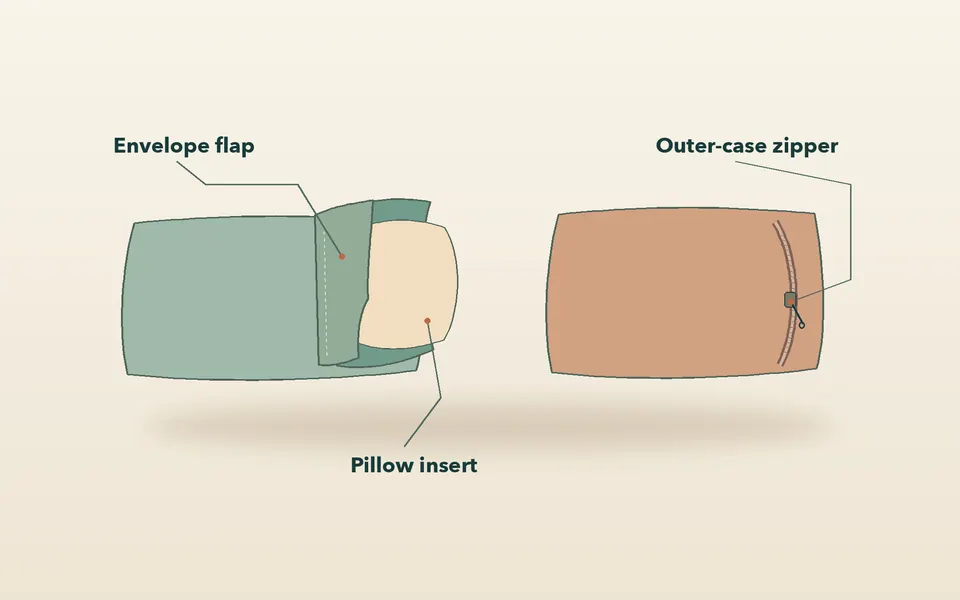
If a pillowcase keeps slipping off, first identify which opening comes undone and whether the case is the intended size for the pillow inside it. When an envelope flap has already failed, buying another case described only as “envelope closure” leaves the important questions unanswered: how much fabric tucks over the pillow, how it fits your insert, and whether you would prefer a zipper on the outer case.
You can investigate those details while keeping a pillow whose shape you already like. This guide compares construction and fit; Coolkeel has not slept on or measured the products below, and a different closure is not evidence of overnight cooling.
Check the layer that actually slips
Remove the loose outer case and identify any separate protector underneath. Keep those two objects distinct when searching. “Pillow cover” can refer to either, so the name alone is not enough.
| What you observe | What to check next |
|---|---|
| The pillow emerges through an open end | The intended insert size and the case’s opening or tuck arrangement |
| An envelope flap comes untucked | Whether the pillow sits within the intended dimensions and the flap can fold fully over its end |
| A zippered protector stays closed but the outer case slips | The outer case’s closure; the protector has not closed that separate opening |
| A zipper is difficult to close around the pillow | Stop forcing it and check size, pillow depth and trapped fabric |
Record the pillow’s labelled dimensions, the case’s labelled size and any protector you intend to keep using. Measure the items you already own, but do not invent a universal amount of extra fabric to add: a flat size does not describe every pillow’s thickness or shape.
Compare what the manufacturer actually specifies
These examples were checked on November 9, 2026. They illustrate different constructions, not a ranking or a claim that the products fit the same pillow.
| Exact example | Verified construction | Size information and remaining question |
|---|---|---|
| Brooklinen Classic Percale Pillowcases | 100% long-staple cotton percale. Brooklinen’s sheet details page describes its pillowcases as having envelope closures. | The product’s inch size guide lists pillowcase dimensions of 20 × 27 and 20 × 37. Flap depth was not specified in the information reviewed. |
| VON SCHÜTZ Percale Pillowcase White Pure | An outer pillowcase on the maker’s European storefront, listed as 100% cotton percale with a concealed zipper. | The size selector includes 50 × 70 cm among other options. This is not the same measurement as 20 × 26 inches. The usable zipper-opening length was not specified in the information reviewed. |
| The Company Store Cotton Pillow Protector, O180-S-STANDARD | A cotton zippered protector, identified as such by the seller. | Its Standard size is listed as 20 × 26 inches. This confirms a zippered protector; it does not close a separate outer pillowcase. |
If you want cotton percale and a zipper, the VON SCHÜTZ example demonstrates that this construction exists. It does not establish compatibility with your pillow or delivery to your address. Check the exact size and seller before ordering. If you prefer an envelope case, ask what differs from the one that already slipped; the closure name alone is not a fit specification.
Keep intended pillow size and finished case size separate
The MUJI USA Washed Cotton Pillowcase shows why this distinction matters. Its extra length is intended to tuck inside instead of closing with a zipper. The page identifies a Japan Standard pillow size of 43 × 63 cm, while listing that case’s finished size as 42 × 85 cm. Its larger option lists a 50 × 70 cm pillow size and a 49 × 92 cm finished case.
Do not treat the longer finished measurement as room for a correspondingly longer pillow: part of that fabric has a closing job. MUJI also warns that its bedding sizes differ from standard US/Canadian sizing. These figures belong to this specific listing, not to every product called Standard or Queen.
For a candidate you are considering, copy these fields into a note:
- Your insert: labelled width and length, its shape, and any protector you will retain.
- Intended insert size: the manufacturer’s stated pillow size, if given.
- Finished case size: measured fabric dimensions, kept separate from the insert size.
- Closure: open end, tuck-in extension, envelope flap or zipper; record the opening location too.
- Missing measurement: flap depth or usable zipper opening. Leave it unknown until confirmed.
Ask the seller: “My pillow is labelled ___ and I use ___ over it. Is your listed size the intended insert size or finished case size? How long is the opening, and how much fabric tucks over the pillow?” This gives the seller a specific fit question instead of asking whether a case “stays on.”
Make the next decision before washing or sleeping on it
For a case you already own, check that the pillow reaches the far corners and that the closing fabric is arranged as its maker intends. If that still leaves the same opening exposed, record the failure rather than repeatedly changing brands with the same unspecified closure.
For a potential purchase, establish which inspections or trials the seller permits before opening, washing or using it. A zipper can close an outer case, but its position, ease of use and fit still matter. Retain uncertainty if the seller cannot explain a critical measurement; you do not need to buy an unsuitable size just because it has the requested closure.
If the pillow’s height or shape is the actual problem, use the case-versus-pillow decision guide. For cleaning the layers you keep, use the pillow cover and core care checklist.
Questions and answers
Will an envelope pillowcase always stop my pillow slipping out?
Do not assume that. Check whether the pillow fits the intended size and whether the flap remains tucked over its end. If an envelope closure has already failed for you, another envelope case needs a specific fit or construction difference to justify trying it.
Can I get a zippered cotton pillowcase rather than silk?
Yes. The VON SCHÜTZ Percale Pillowcase White Pure reviewed here lists 100% cotton and a concealed zipper. Its size selector uses centimetres. Match the selected dimensions and opening to your pillow; the existence of a cotton zipper option does not prove that any listed size will fit yours.
Is a zippered pillow protector the same as a pillowcase?
Read the exact product's intended use. A protector fitted underneath a separate pillowcase closes the inner layer; it does not close that outer case's opening. If the fabric against your face is what keeps slipping, assess the outer case itself.
Can I compare every pillowcase by its advertised length?
First check what that length describes. A listing may give the intended pillow size or the finished case size, including fabric that tucks inside. Those measurements are not interchangeable. Keep both fields where the manufacturer provides them.