The 3 a.m. · comparison
Cooling Pillowcase vs Cooling Pillow: What Should You Change First?
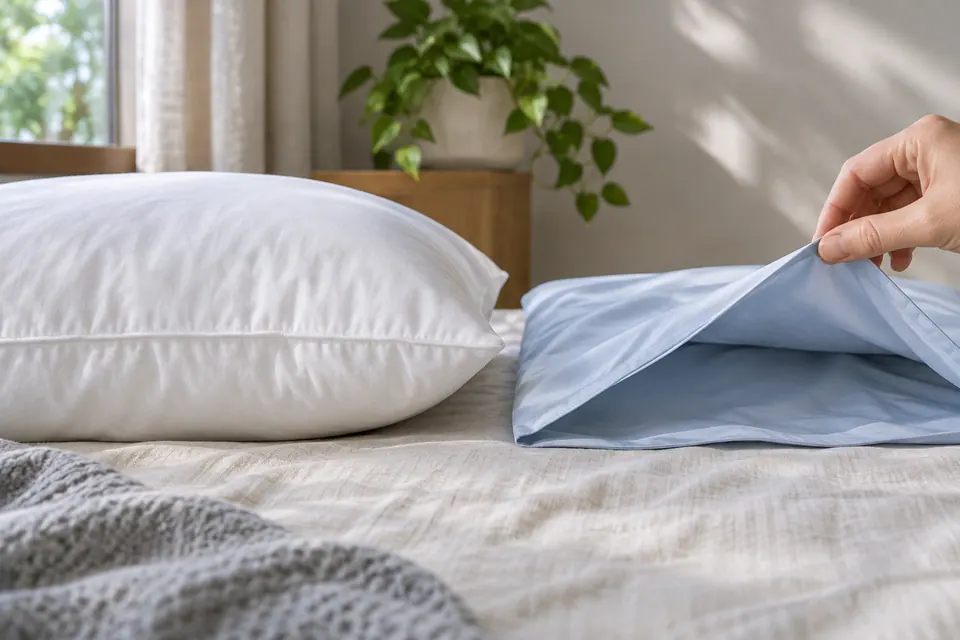
If you like your pillow’s shape but dislike the fabric against your cheek, start by assessing the case. If the pillow feels too high, too low or awkward to settle on, compare pillows. A cooling label alone does not tell you which change will address your complaint.
This guide covers ordinary pillows and cases sold with cooling claims. Powered cooling systems need a different assessment, including their operating and safety instructions.
Name the part you want to change
Before shopping, finish this sentence: “I want to change ___ about my current pillow.” Be specific about surface texture, dampness, shape or cleaning. “Better sleep” is too broad to help choose between these two purchases.
| Your main complaint | What to assess first | What remains unresolved |
|---|---|---|
| The case feels rough or unpleasant | A different case, including an ordinary one you already own | Pillow height and fill |
| The pillow’s height or firmness feels wrong | A replacement pillow or its permitted adjustment | Whether its cover suits you |
| You want a fresh case within reach | A spare that fits and is easy to change | Why you are sweating |
| The whole bed feels uncomfortable | Sleepwear and bedding as a separate decision | A pillow change cannot be assumed to address the whole bed |
You do not need a cooling-labelled item to explore a different surface. A clean spare case can help you decide whether changing the case is useful before buying anything.
Match the cooling claim to the evidence
A listing might describe a cool-touch cover, a gel component or a particular fill. Ask which component was tested. A result for a cover sample is not a result for the complete pillow with your usual case and protector.
KATO TECH’s KES-F7 explanation identifies qmax as peak heat flux at contact. It also describes separate measurements for other thermal properties. A qmax figure therefore does not establish an overnight cooling duration.
For a claim such as “cooler for hours,” ask what was measured, for how long, under what conditions, and against which comparison. Treat that duration as unverified if the seller cannot supply relevant evidence.
Compare the practical details
Measure your existing pillow rather than relying only on “standard” or “queen.” Check the case opening, closure and dimensions. Consider whether you can remove it easily when tired, and whether a zip or seam lands where you rest your face.
For a pillow, distinguish the outer case, removable cover and inner core. Ask which parts can be washed, how they must dry, and whether replacement covers are available. For either purchase, read the actual care instructions; do not assume every cooling fabric needs the same wash temperature or that every fill is washable.
Check return conditions before using or washing the item. Bedding policies may distinguish an unopened item from a used one. Compare the delivered price, any return costs and the number of cases included, rather than using a generic price range to judge quality.
Try one change at a time
If the return terms allow a home trial, keep the pillow and other layers the same while trying a case. Note whether you prefer the texture, whether the case stays in place and whether changing it is straightforward. These are personal observations, not a laboratory result or proof that the case changed your sweating.
If you replace the pillow, evaluate its shape and the case separately. There is no need to buy both because they share the word “cooling.”
For a spare-case routine, see a bedroom night-sweats change kit. If your clothing is the part you want to adjust, use what to wear to bed to plan that change.
Questions and answers
Can I use a cooling pillowcase on my existing pillow?
Check the case's actual dimensions against your pillow, including its depth, and follow both items' instructions. A new case changes the contact surface; it does not change the pillow's underlying shape or fill.
Does a higher qmax mean a pillow stays cool all night?
No. qmax describes peak heat transfer at contact. It does not establish how long a complete pillow will feel cool in your bed. Ask for evidence that matches any separate duration claim.
Should I remove my pillow protector to feel more cooling?
Check the pillow and protector instructions first. Compare the case with the layers you intend to keep using, and ask whether the seller's test included those layers.
Do I need to buy a cooling pillow and case together?
No matching set is required by this guide. If you like your current pillow's shape, you can consider a case alone. If the shape is the issue, assess a replacement pillow separately.