Away · process
Taking a Fan Abroad: Check Power Labels Before Choosing an Adapter
A fan’s plug fitting a socket does not establish that the fan can use that supply. Before an international trip, identify the exact fan, any separate power unit and the destination’s electrical supply. Choose an adapter only after those details are clear.
This checklist concerns using or charging a fan at your destination. Airline battery rules and permission to operate a fan aboard a vehicle are separate decisions. It does not approve a converter, wiring modification or an unverified combination of parts.
Photograph the whole power arrangement
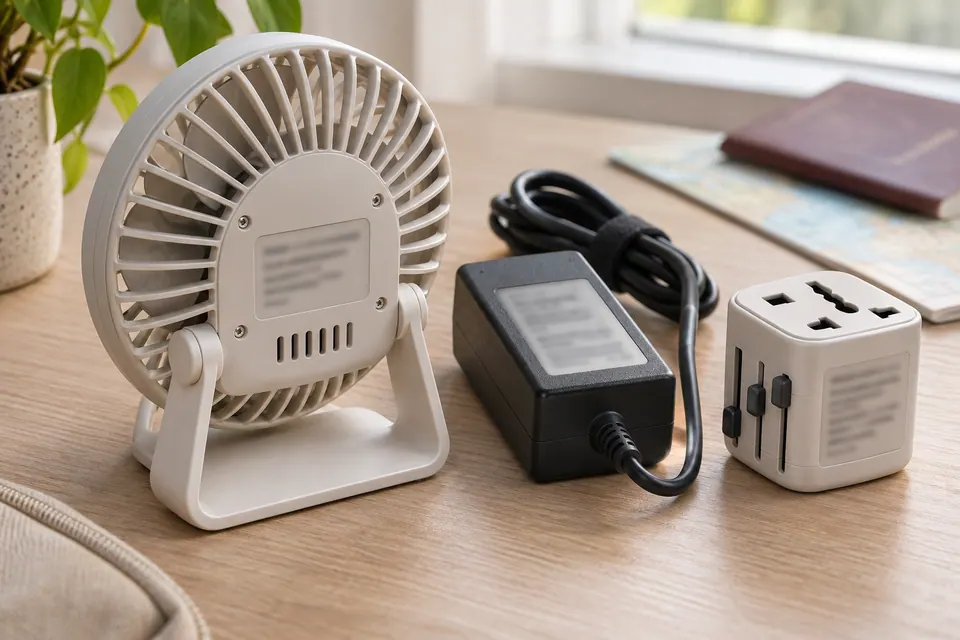
Lay out the fan, its usual cable and any supplied power unit while disconnected. Photograph each rating label and note the model and market where you bought it. Save the matching manufacturer’s instructions, including any restrictions on where or how it can be used.
A mains-powered fan may connect directly to the wall. Another fan may have a separate power unit between the wall and the fan. For a USB-powered or rechargeable model, identify the actual charging arrangement you plan to bring. A familiar connector is not a complete specification.
| Detail to record | Where to look | Question it must answer |
|---|---|---|
| Model and regional version | Fan label and matching manual | Are these instructions for this unit? |
| Input voltage and frequency | Label on the component connected to mains | Does it match the intended supply? |
| Separate power unit | Its model, input and output labels | Is this the supply specified for the fan? |
| Plug and earth requirement | Appliance and adapter instructions | Does the proposed connection preserve the required arrangement? |
| Adapter’s permitted load | Exact adapter label and instructions | Is this appliance within its limits? |
| Destination supply | Official destination guidance and accommodation information | What voltage, frequency and outlet will you actually encounter? |
Record missing information as unknown. A scraped-off label or a seller’s statement that a fan is “international” is not a substitute for model-specific instructions.
Separate three different checks
Plug shape: the connection must suit the destination outlet. A product called universal may still have exclusions in its instructions.
Supply compatibility: Electrical Safety First explains that travel adapters do not change voltage or frequency. Its guidance also distinguishes earth requirements and adapter load limits. Passing the shape check leaves these questions open.
The complete set of parts: if you are replacing a charger or adding another accessory, get confirmation for that actual combination. Do not borrow the compatibility claim of a different fan, regional version or wall charger.
A label showing a range such as 100–240 V is useful evidence about the component carrying it. It does not automatically establish that every other part in your bag is appropriate. Keep the label photograph beside the proposed setup so the manufacturer can see exactly what you mean.
Work through a real mismatch
Dreo’s Tower Fan 307 support page lists several versions and separate regional manuals. Its U.S. troubleshooting guidance specifies 120 V, 60 Hz. This is an example of a regional requirement, not a specification for every Dreo fan.
Electrical Safety First lists the U.K. supply as 230 V, 50 Hz. Meanwhile, Go Travel’s USA–UK adapter explicitly says it does not convert voltage.
The practical conclusion is limited but clear: that adapter alone does not resolve this example’s voltage and frequency mismatch. Do not plug in to find out whether the fan works. Ask the manufacturer about the exact equipment, or arrange an appropriately specified local fan. This comparison does not recommend a transformer or establish that any converter would make the arrangement acceptable.
Make a trip-specific decision
| What you have established | What to do before packing |
|---|---|
| The actual appliance supply requirements match the destination | Finish the plug, earth, load and manufacturer-instruction checks |
| Voltage or frequency does not match | Leave the adapter-only plan unresolved; seek manufacturer guidance or a local option |
| A separate charger has a broad input range | Verify that charger is appropriate for this fan and planned cable; check its mains connection too |
| The label, manual or regional identity is missing | Obtain a readable label or confirmation before deciding |
| Several countries or accommodations are involved | Make a separate row for each supply and outlet arrangement |
Send the manufacturer a compact question: “I have model [model and region], using power unit [model]. Its labels are attached. At my destination the supply is [confirmed voltage/frequency], and I propose adapter [model]. Is this combination permitted by your instructions?” Do not fill in a value you have not verified.
Ask the accommodation about a locally supplied fan early enough to keep it as a practical alternative. Save the response with your travel notes. An unanswered compatibility question is a reason to revise the packing plan, not an invitation to experiment with an unfamiliar outlet.
Questions and answers
Does a travel plug adapter change the electricity supplied to a fan?
An ordinary plug adapter changes the connection shape, not the supply voltage or frequency. Read the exact adapter and appliance instructions rather than assuming that physical fit establishes compatibility.
Is a 100–240 V label enough to approve my whole setup?
No. Check which component carries that label, its frequency rating and instructions, the required power supply, the adapter's rating and any earth requirement. Unresolved details need manufacturer confirmation.
Does a USB connector mean my fan can be charged anywhere?
It does not identify the complete power arrangement. Check the fan's instructions and the exact wall charger or other supply you intend to use; photograph both labels if you need the manufacturer to confirm the combination.
Can a hotel confirm that my imported fan is compatible?
A hotel can help identify its room outlets and supply and whether it offers a suitable local fan. The fan or power-supply manufacturer should resolve questions about your particular device and proposed adapter.