The 3 a.m. · process
Before Washing Blackout Curtains: Check the Backing and Exact Care Label
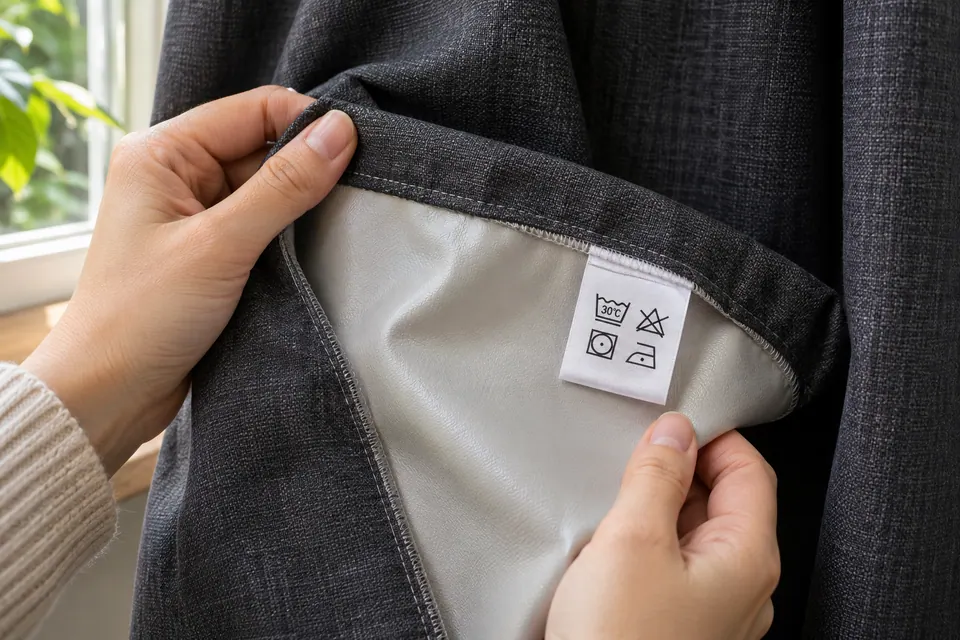
Before washing blackout curtains, identify the exact curtain and read its complete care instructions. A plastic-looking reverse, a polyester description or the word blackout does not settle whether the assembled panel can be washed, soaked, tumble dried or professionally cleaned. If the label is missing, the next step is identification rather than a guessed wash cycle.
A reader with unlabelled blackout curtains asked whether plastic-backed panels should be soaked, hand washed and hung to dry. Their later report that machine washing worked describes that particular experience; it does not identify someone else’s curtain or authorize the same method.
Make an identity record before choosing a cleaning method
Look for a sewn-in label and check the order, packaging or product listing for an article number. Record the purchase country, product name, colour and size. Photograph the front, reverse, heading and any surviving label together, so an enquiry does not show only the decorative fabric.
Treat the curtain panel and an added lining as separate entries until their instructions establish how they are cleaned. Do not detach something that appears sewn or bonded in place just to create a separate washing load. Ask whether the care statement covers the complete panel, a removable lining or fabric sold before it was made into curtains.
| Record field | What to resolve |
|---|---|
| Exact item | Match the article number and market, not just the range name. |
| Face and reverse | Copy stated materials; leave an unidentified backing unknown. |
| Added lining | Establish whether it has its own label and cleaning instructions. |
| Heading and fittings | Locate the maker’s directions for preparation and reattachment. |
| Complete care route | Keep washing, bleaching, drying, ironing and professional cleaning as separate decisions. |
This record is useful even when the answer is incomplete. “Polyester face; backing unidentified; cleaning permission unresolved” communicates more than “probably washable.”
Two named blackout curtains still need their own instructions
The following are documentary examples checked on November 18, 2026. Neither is identified as the reader’s curtain, and their instructions do not apply automatically to another size, market or older version.
For IKEA US MAJGULL, grey, article 504.178.12, the material listing gives polyester. Its care section permits a cold machine wash using the durable-press cycle and excludes bleaching, tumble drying and dry cleaning. The material field does not separately identify a backing; that omission is not proof of a particular construction.
IKEA US ROSENMANDEL, grey, article 205.562.44 separately identifies polyester fabric and polyurethane backing. This model permits a cold normal-cycle machine wash, excludes bleaching, tumble drying and dry cleaning, and restricts ironing to the front at a low setting.
The practical distinction is the exact instruction, including the cycle and ironing surface. The second example also shows why a backing cannot be assessed from appearance alone: its named material and permitted care come from the same product record. It does not establish a rule for every coated curtain.
Finish the care record before taking the curtains down
Read all the care fields before starting. Permission to wash does not answer how to dry the panel. A prohibition on tumble drying does not, by itself, specify hanging a heavy wet curtain from its existing fittings. If the drying arrangement is unclear, ask for that missing step while the item is still identifiable.
Check the heading preparation as well. Dunelm’s UK curtain-care guidance directs customers to the sewn-in care code; for its pencil-pleat curtains sent for dry cleaning, it describes removing hooks and untying strings beforehand. That is a scoped example to look for in the instructions, not permission to pull apart any heading or fixed fitting.
Keep removable hardware identified with the correct panel. If the maker supplies a preparation or assembly diagram, use it for the specific item. Do not infer that a washing instruction authorizes dismantling a sewn heading, cutting cords or separating a bonded backing.
For choosing compatible hooks and tracks before installation, use the curtain-heading and track checklist. Here the decision is how the already identified curtain may be cleaned.
Missing tag or conflicting advice: send a precise enquiry
If the online page and sewn-in label differ, retain both and ask which applies to your article and purchase version. Do not average the instructions into a milder-looking recipe. Hand washing and professional cleaning also need permission; neither is an automatic fallback for an unknown item.
A useful message is: “I have curtain article ___, purchased in ___, with the attached photos of its reverse and remaining label. Does this instruction cover the complete panel and backing? Please confirm the permitted cleaning method, any removable fittings, drying arrangement and ironing surface. The label says ___ while the current page says ___.”
For an unidentifiable secondhand panel, explain that the maker and care label are missing when asking a curtain-cleaning professional to assess it. Do not present another product’s instructions as its label. If no applicable method can be established, leave the cleaning decision open; this checklist cannot turn unknown construction into a washing permission.
Keep the confirmed response with the photographs for the next clean. For removable window shades rather than fabric curtains, the rental-bedroom shade checklist covers the separate mounting and access questions.
Questions and answers
Can I machine wash blackout curtains with a plastic-looking backing?
Appearance does not identify the material or permitted cleaning method. Find the exact curtain and its own care instructions before choosing machine washing, hand washing or professional cleaning.
Does a polyester label mean the whole curtain is washable?
A fibre description is not a cleaning instruction. Check whether it describes the face fabric, backing or separate lining, and read the care directions for the complete item.
What should I do if the curtain care tag is missing?
Use an order record, article number and photographs to ask the maker or seller for the matching care instructions. If the item cannot be identified, keep the cleaning method unresolved rather than borrowing another curtain's recipe.
Can I dry clean any curtain instead of washing it?
No universal substitution follows from uncertainty about washing. The two IKEA US examples discussed here specifically prohibit dry cleaning. Confirm the professional-cleaning permission for your own item.