The 3 a.m. · process
Curtain Width: How to Read One Panel, a Pair and Finished Pleats
A curtain listing gives you two separate pieces of information: how wide the curtain is and how many are in the package. Before multiplying anything, find out whether the seller measured loose fabric, a finished pleated panel or the space the pair should cover. The same number can produce very different orders.
One reader with a 110-inch-wide window wanted to split a pair down the middle. They had found a fullness recommendation but could not tell whether to apply it to each curtain or both together. Their first missing measurement was the span of the fitted pole. Their second was the meaning of “width” on the chosen listing. Original reader question
Start with the span the curtains have to cover
For an existing straight pole, measure between the decorative end pieces, called finials. A wide finial adds to the outside length of the hardware but gives the curtain nowhere else to travel. For a straight track, measure the track as directed for the particular order. Record the glass width separately if you also want to judge how much glass remains exposed with the curtains open. Dunelm UK measuring guide
If the track crosses over itself at the centre or turns back toward the wall, make a sketch and label the straight span, overlap and returns separately. Look up which segments the seller needs before adding them. Likewise, decide which side each panel will cover. Two equal panels can meet in the middle. A panel drawing to one side has to cover its whole intended span on its own. Check any centre support that limits travel before choosing a one-sided arrangement.
Read the width field and the pack contents together
| Wording on the exact listing | What to record | How to use it |
|---|---|---|
| Flat width per panel | Width of one curtain and panels per package | Multiply by the number of panels you intend to hang. |
| Combined flat width of a pair | Width of the complete pair | Use it once for that pair. |
| Finished coverage per pleated panel | Extended width across its finished heading | Allocate the required coverage to each panel, following that maker’s allowances. |
| Whole track or pole width required | Measurement requested on the order form | Supply the hardware measurement using that form’s instructions. |
Check whether the other dimension is the drop, measured vertically. Also look for the product’s own measurements rather than the dimensions of the folded parcel. If the seller only gives “width × drop” without identifying one panel or both, ask what comes in one pack and whether the stated width is flat or finished before ordering.
Work one ready-made example in the same units
IKEA UK’s light-grey MAJGULL with heading tape, article 303.467.50, is listed as 145 × 250 cm. Its description says those dimensions apply to each curtain and one pair is included. That gives two widths of 145 cm, or 290 cm of curtain across the pair before gathering. The 250 cm figure is the length. IKEA UK MAJGULL product measurements
Suppose your own pole has a usable span of 180 cm. One such pair gives a fabric-to-span ratio of 290 ÷ 180, approximately 1.61. A single panel from that package would have only 145 cm available for a 180 cm span, even before forming folds. If you split the pair evenly, each 145 cm panel serves about 90 cm of pole. The combined and per-side calculations give the same ratio.
Use that calculation to compare two pack sizes on your own measurements. Decide whether the resulting folds suit the selected heading using the maker’s advice. For a curtain that comes singly, calculate the number of individual panels first and translate that into packs. For a pair pack, buying two packs would put four panels in the basket. Decide where those panels would hang before increasing the quantity.
A sewn pleat or a custom order changes the calculation
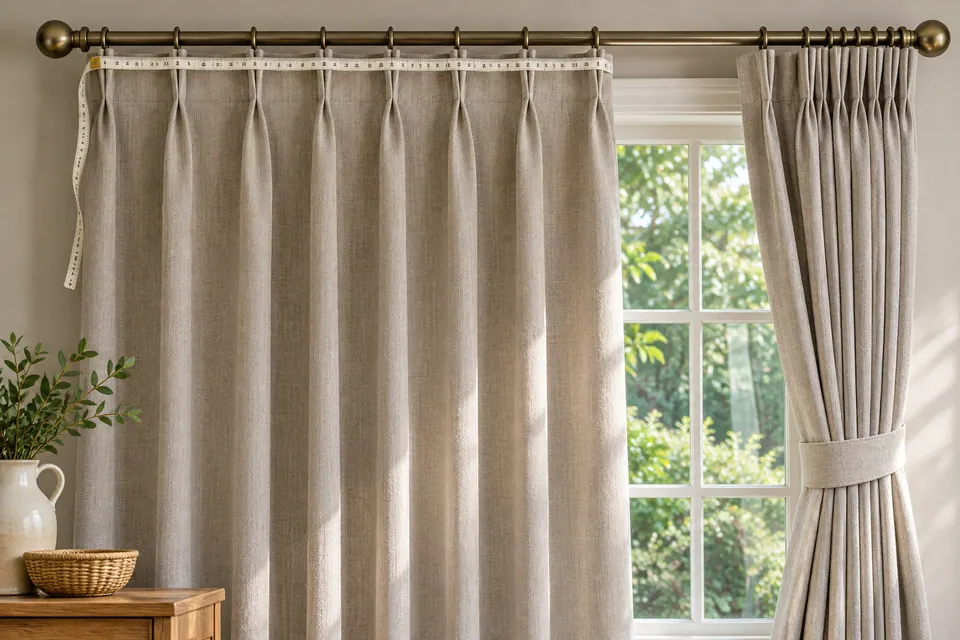
TWOPAGES UK’s guide distinguishes headings on its own order form. For its pleated styles, the width to order is the finished coverage of one extended panel. The fabric needed to make the sewn pleats is already incorporated. In the guide’s standard equal-pair example, the buyer divides the pole width between the panels. Its soft-top panels use a flat-width calculation instead. Check the heading selected on the actual order before reusing a measurement. TWOPAGES UK finished-width guide
A different UK order form, Curtains Made Simple’s Casual Midnight by Warwick, asks for the track or pole width. The maker calculates the fabric allowance for pleating. Entering half the pole width because you want two curtains, or multiplying the pole width before entering it, would change the measurement the form requests. Curtains Made Simple ordering instructions
Keep one measurement record before checkout
Save the article number, market, selected heading, draw direction, usable span and units. Copy the label on the width field exactly. Add the stated width, whether it is per panel or combined, panels per pack, packs in the basket and any maker-specified overlap. Leave an unclear field open until the seller identifies it.
Width answers how much material or finished coverage you are ordering. The separate curtain heading and track checklist helps check whether those panels will attach to the hardware you have. Even a pair with the intended fabric width can leave light around the top or sides. Check those edges on the actual installation before drawing conclusions about bedroom light.
Questions and answers
When curtains are listed as a pair, is the width for both?
Look for the width definition and the number supplied on the exact listing. IKEA UK's MAJGULL article 303.467.50 gives the width of each curtain and includes two. A seller that lists a combined pair width has already added the two panels.
Do I use the width of my window or curtain pole?
For a fitted straight pole, measure the working span between the decorative ends. For a track with an overlap arm or returns, follow the seller's track instructions and record those measurements separately.
How do I calculate the fullness of ready-made curtains?
For panels specified at their flat width, divide their combined flat width by the span to be covered, using the same units. Compare the result with the chosen heading's guidance. The ratio describes fabric allowance and does not establish whether the centre closes neatly.
Do I add fullness to the width for pinch pleat curtains?
Read the order form. A maker may ask for the finished coverage of each sewn pleated panel or for the whole fitted track span. Each already allows for pleating in its own way. Adding extra fabric width yourself can oversize the order.