The 3 a.m. · process
Dehumidifier Hose Attached but Bucket Filling? Check the Drain Route
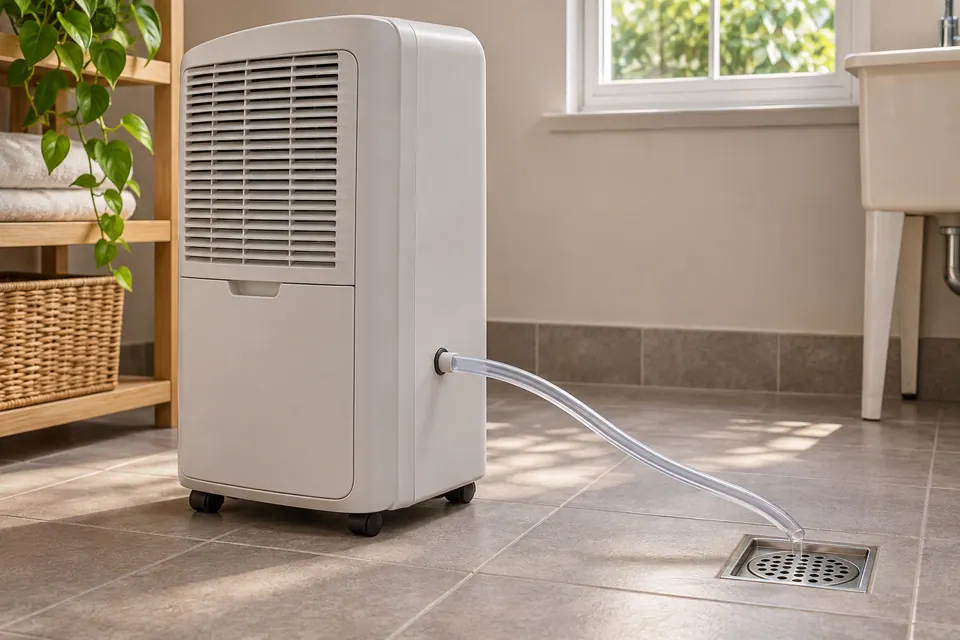
A hose attached to a dehumidifier is only part of a drainage setup. Match the outlet and operating mode to the exact manual, then trace the hose all the way to its discharge point. A bucket that continues to fill is an observation to investigate, not proof of a broken pump or a specific internal blockage.
This guide is for checking an existing appliance’s external drain arrangement. If you are still deciding whether to buy one for a warm bedroom, start with what a dehumidifier can and cannot do for room cooling.
Identify the mode before inspecting the route
Record the model number from the appliance label, country of purchase and matching owner’s-manual link. Then find the diagram titled drainage or removing collected water. Do not identify the connection solely from a similar-looking machine in a discussion thread.
Separate these questions:
- Gravity: Which outlet and hose does the manual specify, and can the route descend to the drain?
- Pump: Does this exact version have a pump, which connection does it use, and what setup and discharge limits apply?
- Bucket: What must remain fitted during the chosen mode, even if the bucket was removed temporarily to reach a connection?
A “continuous” humidity setting is not enough evidence to select a pump outlet. Use the drainage section and model-specific controls together.
Compare the diagram with the actual appliance
These US-market documentation examples illustrate why port location and mode need to be recorded. They are not a universal installation sequence, and we have not tested either appliance.
| Exact model and source | What the drain diagram establishes | What to record on your unit |
|---|---|---|
| GE ADHL50LB / APHL50LB, owner’s manual 49-5000545 Rev. 4, pages 7–8 | A garden-hose gravity connection reached through a side cover; a separate rear pump-hose connection on equipped models | Which illustrated outlet you are using and whether the selected procedure applies to your model |
| Frigidaire FFAD5034W1, linked owner’s guide, pages 15–16 | A rear drain cap and threaded garden-hose connection | The matching cap, connector and hose specification |
For the GE models, the gravity hose runs down to a floor drain and the bucket is returned to its operating position. The pump procedure instead uses the supplied pump hose and its activation instructions. Page 8 illustrates more than one connector-release style: match the actual fitting before handling it. GE ADHL50LB support and manual, GE APHL50LB support and manual
The Frigidaire guide specifies a drain hose of 1/2 inch (12.7 mm) or larger, with no kinks or elevated sections. It also covers the connection seal and refitting the drain cap when no hose is attached. Those details belong to that guide; do not transfer its hose size or cap arrangement to an unidentified model. Frigidaire FFAD5034W1 support and owner’s guide
Trace the whole external hose, not just its end
For a gravity arrangement, look from the connection toward the drain. A lower endpoint does not tell you whether an intermediate section rises over a container edge or another object. Keep a side-view photo that includes the entire route.
GE’s hose-troubleshooting guidance calls for downward drainage and warns against a hose end pushed too far into, or submerged in, the drain. It also identifies a poor connection as a possible reason water goes into both the hose and bucket. Frigidaire likewise lists hose obstruction as a possible source of backed-up water. These are checks, not a diagnosis of your appliance. GE drain-hose troubleshooting, Frigidaire drainage troubleshooting
Use the following record before deciding what to change:
| Check | Observation to write down | If unresolved |
|---|---|---|
| Outlet and mode | Photo label matched to the manual’s gravity or pump diagram | Confirm the model and applicable procedure with the maker |
| Hose | Markings, fitting and specified accessory; visible damage or sharp bends | Ask for the correct hose rather than adapting an uncertain fitting |
| Complete route | Every rise, sag or squeezed section, plus the discharge point | Find a supported route; do not improvise a stand to force a height difference |
| Drain endpoint | Where the outlet ends relative to the drain and standing water | Ask whether this arrangement meets the model’s instructions |
| Bucket and display | Bucket position, indicator or error code, selected drainage setting | Follow the matching manual’s checks without bypassing an interlock |
Keep the record factual: “hose rises over this edge” is more useful than “pump seems weak.” If a row cannot be checked, mark it unknown.
Stop at the boundary of an external check
This checklist does not call for removing the casing, inserting a stick into an internal channel, drilling a hole or altering the bucket switch. Follow the owner’s manual for shutdown and safe handling before changing a connection. An unresolved leak, error code or repeated bucket filling belongs with the manufacturer’s support process.
Send support the exact model and market, manual link, selected mode, outlet photo, full hose-route photo and the observed symptom. Ask which documented check applies next. Do not combine pump instructions from one model with gravity instructions from another to fill a gap.
Once drainage is resolved, keep room-temperature and relative-humidity readings separate from water collection. The bedroom hygrometer placement guide covers that different measurement task; a flowing hose alone does not show that the room feels cooler.
Sources checked November 11, 2026. This is an external setup checklist based on the named documentation. It does not establish the cause of a particular fault or promise a drainage, cooling or comfort result.
Questions and answers
Does a full bucket with a hose attached prove the dehumidifier is faulty?
No. Frigidaire's support guidance explains that a blocked hose can send water back into the bucket. GE also lists hose-connection and routing problems. The symptom alone does not identify the cause in your machine.
Can a gravity-drain hose go up into a sink?
Do not treat a gravity outlet as a pump. The GE and Frigidaire examples require a downward route without an elevated section. If your available drain needs a rise, ask the manufacturer about a supported alternative for the exact model.
Should I remove the bucket when I connect the hose?
Check the operating instructions, including what must be reinstalled after connection. In the GE ADHL50LB and APHL50LB manual used here, the bucket must be properly seated for operation, including hose drainage.
What if the hose route looks correct but the bucket still fills?
Record the model, selected drainage mode, outlet, hose specification, route photos and any displayed code. Ask the maker for the next step. This checklist does not authorize opening the housing, drilling, probing internal passages or bypassing a switch.