Away · process
Cooling Gel and Ice Packs: An Airport Security Checklist
Before putting a cooling pack in your cabin bag, establish what it contains, its container capacity, and its likely state at the security checkpoint. Then repeat the rule check for your return airport. A pack that worked on the outbound journey may need a different plan coming home.
This guide covers ordinary personal-comfort ice and gel packs, using official guidance consulted September 30, 2026. It does not establish a medical exemption or guarantee clearance for a particular item. Check the linked authorities again before travel.
1. Match the item and its state to the U.S. rule
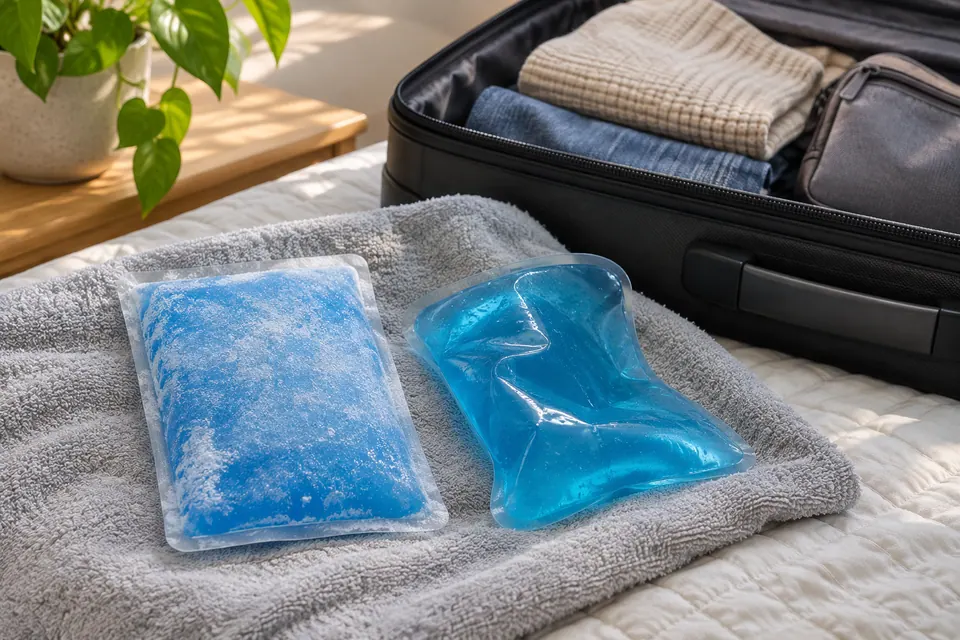
TSA’s Freezer packs and Gel Ice Packs entries distinguish completely frozen items from those that are partly melted, slushy or contain liquid. The latter must meet its ordinary liquids requirements. The assessment is at screening, not when you take the pack out of your freezer. TSA item guidance
| What you have at screening | Rule to check | Practical decision before leaving home |
|---|---|---|
| Ordinary ice or gel pack, completely frozen solid | TSA’s frozen-item instructions | Check whether the manufacturer permits freezing and plan for the journey to the checkpoint. An insulated pouch is not proof that the contents will stay solid. |
| Ordinary pack that is partly melted, slushy or liquid | The carry-on liquids allowance | Confirm the container capacity and whether it fits with your other liquids. Do not rely on its earlier frozen state. |
| Larger pack that may arrive partly melted | Liquid limit, or confirmed checked-baggage requirements | Resolve the alternative before bag drop: check whether this exact item may travel in the hold, or leave it out of your cabin kit. |
| Unclear contents, chemical activation or an unfamiliar phase-change insert | Exact product classification and transport information | Ask the manufacturer and airline about the labelled item. Do not assume every accessory sold as a cooling pack has the same contents. |
For ordinary U.S. carry-on liquids, use containers of 3.4 ounces / 100 ml or less, fitting together in one clear quart-size bag per passenger. The TSA travel checklist describes the bag and per-container requirements. The FAA’s ice-pack note also states that liquid or gel above 100 ml per container must be solid when screened in carry-on baggage.
2. Read the label before deciding where it goes
Record the product name, filler or ingredients, capacity in ml, and the manufacturer’s freezing instructions. Photograph the label for an enquiry. A weight in grams does not establish container volume; ask for the missing capacity rather than estimating from the pack’s dimensions. Do not cut open a sealed gel pack to reduce its contents.
For an unfamiliar chemical or phase-change product, ask the maker for transport information. The FAA recommends obtaining a manufacturer’s safety data sheet when an item’s hazardous-material status is unclear. Its existence alone does not establish passenger-baggage permission. FAA packing guidance
Dry ice is a separate case: FAA guidance requires airline approval and packaging that vents carbon dioxide. Do not add it as an improvised way to keep an ordinary comfort pack frozen. FAA dry-ice guidance
3. Pack for inspection and a change of plan
As a practical packing approach, keep the pack accessible and use a secondary pouch for possible leaks. The pouch does not change the contents’ classification. Check the item before leaving and again before handing over checked luggage, while you can still use your agreed alternative.
Avoid a plan that depends on a particular number of hours remaining frozen. This guide has no test data for your pack, insulation, airport queue or weather. If the capacity is too large for the liquid allowance and you cannot rely on arriving with it fully solid, choose a plan that works without it in your carry-on.
4. Make a separate return and connection checklist
For each airport where you will pass through security, note the airport and terminal, its rules for the exact pack, and a fallback if the pack is no longer frozen. Ask your accommodation whether the necessary freezer is actually available; do not treat a room minibar or refrigerator as confirmation.
The difference can be substantial: GOV.UK’s ordinary liquids guidance says frozen liquids cannot go in hand luggage, and directs travelers to check departure, connecting and return airports. Liquid-container limits also vary between UK airports. A U.S. frozen-pack allowance therefore does not settle a UK departure.
Read exceptions in context. Heathrow’s assistance guide discusses cooling packs accompanying medication that requires temperature control, with relevant documentation. That is not a general permission for a personal-comfort pack.
Use this enquiry outline with the airport’s screening authority and the operating airline:
I plan to carry this product for ordinary personal comfort: product name, label photograph, contents and container capacity. At screening it may be fully solid or partly melted. My departure and connecting airports are listed below. Is this exact item permitted in cabin baggage in those states, and what requirements apply if I pack it in checked baggage instead?
Keep their reply with your itinerary and recheck if the item or route changes. For the rest of your reachable supplies and clothing, use the in-seat travel plan. A battery-powered alternative needs its own fan and battery check.
Questions and answers
What if my cooling pack melts on the way to the airport?
For ordinary U.S. carry-on screening, a partly melted, slushy or liquid-containing pack must meet the TSA liquids requirements. Its state at screening matters, even if it was solid when you left home. Check the container capacity and make an alternative plan before bag drop.
Does a 100 g label mean my gel pack meets a 100 ml limit?
No. Grams describe mass, while millilitres describe volume. Ask the manufacturer for the container's capacity in ml; do not convert an unfamiliar gel by assuming it has the same density as water. A compact-looking pack is not proof of capacity either.
Is a pack for personal cooling automatically medically necessary?
Do not assume that it is. This checklist covers ordinary personal-comfort items and does not establish eligibility for a medical exception. If your pack has a medically necessary purpose, ask the relevant screening authority about your circumstances and required screening steps.
Can I use the same packing plan for an international return flight?
Check again with the departure airport and any airport where you will pass through security. U.S. frozen-pack guidance is not a worldwide rule. Confirm the exact item, applicable liquid restrictions and available freezing arrangements before relying on it for the return.