Away · process
Can This Bottle Go in Your Bag? Check the Lid's Closed State
Before putting a filled bottle inside a bag, match the installed lid to its transport claim and identify the complete closed position. A lid sitting on a cup is not necessarily a sealed closure. “Leak-resistant” also does not supply the same permission as a maker’s conditional leakproof statement.
A public Hydro Flask question describes a press-in tumbler lid leaking and a Flex Sip Lid apparently moving open inside a bag. The reader asks whether a traditional screw cap would solve the problem. That gives us a practical task to investigate, but it does not establish the condition or generation of that person’s lids, or prove that a replacement will solve it.
Identify the vessel and installed lid separately
Start with the full product names, purchase country and any replacement-lid record. A bottle’s capacity or color is not enough to identify its closure. If the lid changed after purchase, the original bottle listing may describe a configuration you no longer have.
The current US Hydro Flask fit chart separates threaded bottle caps from press-in drinkware lids. It lists, for example, 24 oz Travel Tumblers with Medium Lids, while 24 oz Travel Bottles use Wide Mouth caps. “Travel” and “24 oz” therefore do not identify the same opening or accessory family. Hydro Flask accessory fit chart
Record the exact family before comparing transport claims. Do not substitute a Flex Straw Cap for a Flex Sip Lid because both names begin with “Flex,” or use another brand’s cap compatibility claim from a comment as confirmation.
Read the condition attached to the claim
These US examples were checked on November 15, 2026. They compare documented uses, not measured leak performance.
Medium Press-In Straw Lid: its product page describes resistance to leaks and splashes and a snug press-in fit. It lists compatible drinkware, including the 24 oz Travel Tumbler. Those descriptions do not say that this lid becomes a sealed bottle cap when pressed into place. Exact Medium Press-In Straw Lid listing
Hydro Flask’s US guidance explicitly says that its leak-resistant tumblers, mugs and cups are not intended to be placed on their sides or upside down when full. If your bag arrangement requires either position, that is a reason to change the arrangement or choose a combination documented for it. A pocket that fits the cup does not change the lid’s instructions. Hydro Flask lid and cap guidance
Wide Mouth Flex Sip Lid: the specific product page says it fits Wide Mouth bottles, twists open and closed, and is leakproof when closed. Keep that final condition attached to the claim. It is not a promise about a lid left open or an unidentified replacement. Exact Wide Mouth Flex Sip Lid listing
Distinguish closed from attached and unlocked
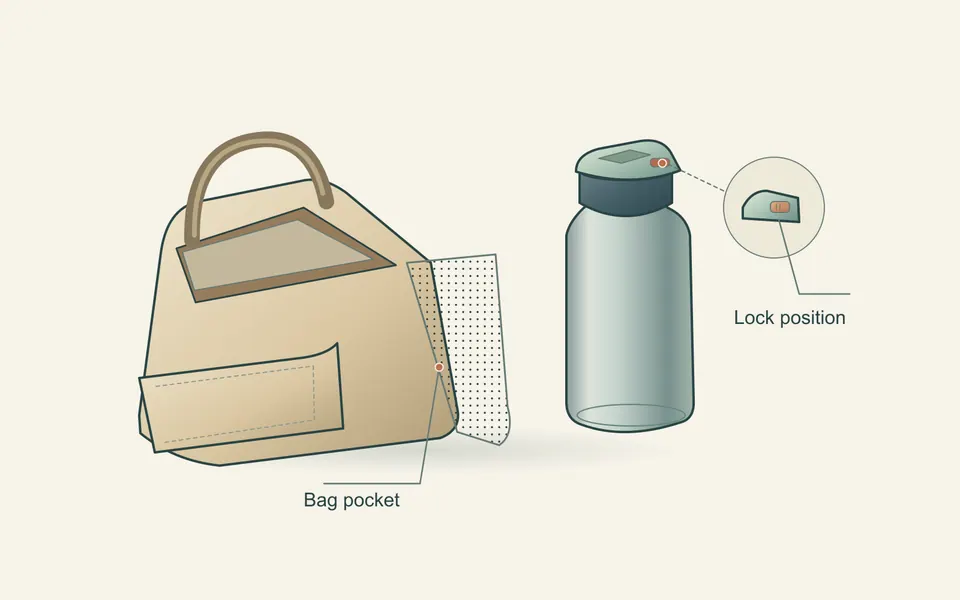
With an empty vessel, identify the normal drinking and closed positions using the matching instructions. Check the lid-to-bottle attachment separately from the drinking opening. Do not assume that tightening one has closed the other.
The official Flex Sip care guide, published May 1, 2024 and still available when checked, labels the closed position red. It then describes moving past that position to unlock the lid for disassembly. That is a different operation from closing it for transport; it is not an instruction to keep turning for a stronger seal. Its reassembly sequence returns the top to the closed position before describing opening it to drink. Flex Sip illustrated care and assembly guide
Use those details only for a lid that matches the named guide. If yours has different markings, missing parts or a mechanism you cannot identify, leave the closure check unresolved. This article does not provide a substitute disassembly sequence, diagnose a failed seal or recommend plugging a vent.
Make a short packing record
Complete these entries before deciding where the filled vessel belongs:
| Check | Record the answer |
|---|---|
| Exact combination | Bottle or tumbler model, installed lid and purchase country |
| Applicable wording | Leakproof under stated conditions, resistant, or not specified |
| Closed state | The matching instruction and visible position you must recognize |
| Intended placement | Upright, sideways or likely to change orientation |
| Unresolved issue | Unknown compatibility, unexpected movement, damage or leakage |
As a practical packing check, use the empty vessel to see whether you can inspect and reach its closure in the proposed compartment. If other contents conceal or interfere with the control, change the layout. This checks access; it does not test sealing or establish that a closure will remain secure during travel.
When the documented conditions cannot be met, do not treat a towel wrapped around the vessel or a successful empty fit trial as permission to pack it full. For an unexplained leak, send the maker the vessel and lid names, purchase country, photographs and the exact position in which the problem occurs. Ask which instructions apply before choosing a replacement.
Keep the remaining checks separate
Beverage permission still needs its own decision: use the exact bottle and lid beverage checklist rather than treating a transport claim as permission for a particular drink. For removable seals and reassembly, use the bottle-lid parts checklist.
The useful outcome is a specific record of the combination, closure and allowed orientation. We have not tested these products in a bag or verified an individual bottle’s condition.
Questions and answers
Can a leak-resistant tumbler travel sideways inside a bag?
Do not infer that permission from leak-resistant wording. Hydro Flask's US guidance says its leak-resistant drinkware is not intended to be placed on its side or upside down when full. Check the exact product rather than borrowing a bottle cap's leakproof claim.
Does a lid being attached mean it is closed for transport?
Not necessarily. A lid can be attached to the vessel while its drinking opening remains open. For the named Hydro Flask Wide Mouth Flex Sip Lid, the manufacturer describes a separate twist-to-close action and makes its leakproof claim conditional on closure.
Should I turn a Flex Sip Lid farther than its closed position before packing?
Do not use the disassembly instruction as an extra closing step. The linked Flex Sip care guide identifies a red closed position and separately describes moving past closed to unlock for disassembly. Match your version to that guide; ask the maker if the positions do not match.
Does this checklist prove that my bottle will never leak?
No. It checks the documented combination and closure requirements. It cannot inspect wear, certify assembly or guarantee that the lid stays closed in your bag. An unexplained leak or a closure you cannot identify remains a reason to ask the manufacturer before relying on it.